
Aktan Erciyes, Aslı
Loading...

Profile URL
Name Variants
Aktan Erciyes,A.
A., Aslı
Aslı Aktan Erciyes
AKTAN ERCIYES, Aslı
Aktan Erciyes, A.
Aktan Erciyes A.
A.,Asli
Aktan Erciyes, Aslı
Aslı AKTAN ERCIYES
Aktan-Erciyes A.
Aktan Erciyes, Asli
AKTAN ERCIYES, ASLI
Aktan Erciyes, ASLI
A. Aktan Erciyes
A., Asli
Aktan Erciyes,Asli
ASLI AKTAN ERCIYES
Asli, Aktan Erciyes
Aktan-Erciyes, A.
Aktan-Erciyes, Aslı
Aktan-erciyes, Aslı
Ercıyes, Aslı Aktan
Aktan-erciyes, Aslı
Ercıyes, Aslı Aktan
Erciyes, Aslı Aktan
Erciyes, Asli Aktan
Aktan-Erciyes, Asli
A., Aslı
Aslı Aktan Erciyes
AKTAN ERCIYES, Aslı
Aktan Erciyes, A.
Aktan Erciyes A.
A.,Asli
Aktan Erciyes, Aslı
Aslı AKTAN ERCIYES
Aktan-Erciyes A.
Aktan Erciyes, Asli
AKTAN ERCIYES, ASLI
Aktan Erciyes, ASLI
A. Aktan Erciyes
A., Asli
Aktan Erciyes,Asli
ASLI AKTAN ERCIYES
Asli, Aktan Erciyes
Aktan-Erciyes, A.
Aktan-Erciyes, Aslı
Aktan-erciyes, Aslı
Ercıyes, Aslı Aktan
Aktan-erciyes, Aslı
Ercıyes, Aslı Aktan
Erciyes, Aslı Aktan
Erciyes, Asli Aktan
Aktan-Erciyes, Asli
Job Title
Doç. Dr.
Email Address
Main Affiliation
Psychology
Psychology
03. Faculty of Economics, Administrative and Social Sciences
01. Kadir Has University
Psychology
03. Faculty of Economics, Administrative and Social Sciences
01. Kadir Has University
Status
Current Staff
Website
ORCID ID
Scopus Author ID
Turkish CoHE Profile ID
Google Scholar ID
WoS Researcher ID
Sustainable Development Goals
15
LIFE ON LAND

0
Research Products
16
PEACE, JUSTICE AND STRONG INSTITUTIONS

0
Research Products
14
LIFE BELOW WATER

0
Research Products
6
CLEAN WATER AND SANITATION

0
Research Products
3
GOOD HEALTH AND WELL-BEING

0
Research Products
17
PARTNERSHIPS FOR THE GOALS

0
Research Products
4
QUALITY EDUCATION

1
Research Products
2
ZERO HUNGER

0
Research Products
10
REDUCED INEQUALITIES

0
Research Products
7
AFFORDABLE AND CLEAN ENERGY

0
Research Products
13
CLIMATE ACTION

0
Research Products
1
NO POVERTY

0
Research Products
9
INDUSTRY, INNOVATION AND INFRASTRUCTURE

0
Research Products
12
RESPONSIBLE CONSUMPTION AND PRODUCTION

0
Research Products
8
DECENT WORK AND ECONOMIC GROWTH

0
Research Products
11
SUSTAINABLE CITIES AND COMMUNITIES

0
Research Products
5
GENDER EQUALITY

0
Research Products

This researcher does not have a Scopus ID.

This researcher does not have a WoS ID.

Scholarly Output
37
Articles
31
Views / Downloads
215/1708
Supervised MSc Theses
5
Supervised PhD Theses
0
WoS Citation Count
121
Scopus Citation Count
143
WoS h-index
8
Scopus h-index
8
Patents
0
Projects
0
WoS Citations per Publication
3.27
Scopus Citations per Publication
3.86
Open Access Source
19
Supervised Theses
5
| Journal | Count |
|---|---|
| Journal of Child Language | 5 |
| Journal of Language and Linguistic Studies | 3 |
| Infant and Child Development | 2 |
| First Language | 2 |
| Dil ve Dilbilimi Çalışmaları Dergisi | 2 |
Current Page: 1 / 5
Scopus Quartile Distribution
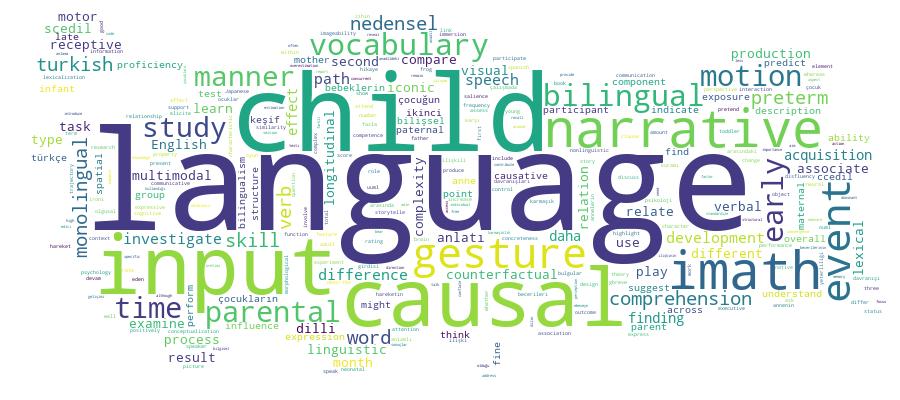
Competency Cloud
37 results
Scholarly Output Search Results
Now showing 1 - 10 of 37
Article Citation - WoS: 4Citation - Scopus: 4Influences of early and intense L2 exposure on L1 causal verb production: Comparison of 5-, 7-, and 9-year-old bilingual and monolingual children(Sage Publications Ltd, 2024) Aktan-Erciyes, Asli; Ger, Ebru; Goksun, TilbeThis study investigates the influences of early and intense L2 exposure on children's L1 causative verb production, assessed by an experimental causative verb production task. Turkish expresses causality by morphological and lexical means, whereas English does so by periphrastic and lexical means. Learning L2 English might enhance L1 Turkish causative verb production by highlighting the parallels and contrasts in causal expressions between the languages, which may result in an enriched L1 causative use. Five-, 7 -, and 9-year-old L1-Turkish L2-English bilingual (n = 80) and L1-Turkish monolingual (n = 80) children participated in the study in L1-Turkish. Results indicated that language group differences only emerged for the use of morphological causative verbs in favor of 5-year-old bilinguals compared with monolingual peers. Age group differences occurred only for the monolingual group and only for morphological verbs. Specifically, monolingual 7- and 9-year-olds performed better than monolingual 5-year-olds. Causative verb-type differences were only seen for 5-year-old monolinguals, who performed better for lexical than morphological verbs; in contrast, 5-year-old bilinguals performed equally well on the two types of causatives, and better than 5-year-old monolinguals on morphological causatives. Overall, these findings indicate that learning an L2 with structural similarities and differences compared with L1 might enhance children's awareness and correct use of causal linguistic structures.Article Citation - WoS: 2Citation - Scopus: 2Linguistic and nonlinguistic evaluation of motion events in a path-focused language(Cambridge Univ Press, 2022) Aktan-Erciyes, Asli; Akbuga, Emir; Dik, Feyza Nur; Goksun, TilbeThis study examines how properties of path (the trajectory of motion) and manner (how an action is performed) components of motion events are reflected in linguistic and nonlinguistic motion event conceptualization in a path-focused language, Turkish. In two experiments, we investigated how path and manner differed in salience (i.e., prominence) and ease of expression (EoE, i.e., effort of describing), and how these factors were related to lexicalization and similarity judgments of motion events. In Experiment 1, participants rated motion events based on path and manner salience and EoE and expressed path and manner in a written format. Results indicated that manner was rated as more salient and path as easier to express. Path salience and EoE were related to both types (i.e., number of different expressions) and the total number of paths and manners used. However, manner EoE but not salience was associated with only types and the total number of manners used. In Experiment 2, participants rated the similarity of motion event pairs created using the ratings in Experiment 1. We found that higher manner salience and EoE difference were associated with lower similarity ratings. These findings suggest that salience and EoE of path and manner are related to both linguistic and nonlinguistic aspects of motion event conceptualization.Article Citation - WoS: 6Citation - Scopus: 7Motion Event Representation in L1-Turkish Versus L2-English Speech and Gesture: Relations To Eye Movements for Event Components(Sage Publications Ltd, 2023) Aktan-Erciyes, Asli; Akbuga, Emir; Kizildere, Erim; Goksun, TilbePurpose: We investigated interrelations among speech, co-speech gestures, and visual attention in first language (L1)-Turkish second language (L2)-English speakers' descriptions of motion events. We asked whether young adults differed in their spoken, gestural expressions, and visual attention toward event components of manner (how an action is performed) and path (the trajectory of an action) after controlling for their L2 proficiency. Methodology: Participants were 49 native Turkish speakers (M-age = 20.98) whose second language is English. After watching each video (recording eye movements), they were asked to describe the motion event videos, and their speech and gesture were coded. English competence level was measured using a standardized assessment. Data and Analysis: We performed analyses of covariance (ANCOVAs) to investigate both within- and across-language differences for L1-Turkish and L2-English spoken and gestural expressions. To analyze eye-gaze behaviors with respect to language and event component differences, we performed t-tests. Last, hierarchical linear regressions were conducted to examine the relationship between visual attention and the use of path and manner in speech and gesture separately. Findings: For L1-Turkish speech, participants used more path than manner constructions, indicating no particular effect of L2 on L1. For L2-English, participants used similar amounts of path and manner descriptions. Path gestures dominated for both L1-Turkish and L2-English. Participants allocated more attention to figures possibly related to manners rather than grounds (paths). There was no effect of L2 proficiency on verbal and gestural explanations or visual attention to events. Originality: This study adopts an integrative approach through investigating speech, gesture, and eye-gaze behavior patterns in motion event conceptualization while also addressing L1 and L2 differences within this framework. Implications: These findings highlight the similarities in visual attention and the use of gestures across L1-Turkish and L2-English motion event descriptions, and only an expected difference in verbal expressions.Article Citation - WoS: 13Citation - Scopus: 18A Multidimensional Investigation of Pretend Play and Language Competence: Concurrent and Longitudinal Relations in Preschoolers(Elsevier, 2020) Kızıldere, Erim; Aktan Erciyes, Aslı; Tahiroğlu, Deniz; Göksun, TilbePlay is an important tool for children's social interactions and cognitive skills. The current study examines the links between pretend play and language in 119 Turkish preschoolers at two time points tested one-year apart (Time 1 M-age = 45.82 months and Time 2 M-age = 57.68 months). Preschoolers' language competence (linguistic complexity and receptive vocabulary) was assessed along with several pretend play measures (telephone task, imaginary pantomime task, pretense score from a free play session). Results showed that concurrently the telephone and imaginary pantomime task scores were associated with linguistic complexity at Time 1 and only the telephone score was related to linguistic complexity at Time 2. No concurrent associations were found between receptive vocabulary and pretend play measures. Furthermore, a longitudinal relation was found between language competence and one pretend play measure: Time 1 telephone score predicted Time 2 receptive vocabulary score. These findings are discussed in terms of the two domains potentially sharing the symbolic aspect as an underlying mechanism and social aspect through pretense creating contexts relevant to language development.Article Citation - WoS: 9Citation - Scopus: 8Fine Motor Abilities and Parental Input of Spatial Features Predict Object Word Comprehension of Turkish-Learning Children(WILEY, 2021) Kobas, Mert; Aktan-Erciyes, Aslı; Göksun, TilbeObject word learning can be based on infant-related factors such as their manual actions and socio-linguistic factors such as parental input. Specific input for spatial features (i.e., size, shape, features of objects) can be related to object word comprehension in early vocabulary development. In a longitudinal study, we investigated whether fine motor abilities at 14 months and parental input for spatial features at 19 months predicted object word comprehension at 25 months. Twenty-seven Turkish-learning children were tested at three time points (Time 1: M-age = 14.4 months, Time 2: M-age = 18.6 months, Time 3: M-age = 25 months). We measured word comprehension through the parental report and fine motor abilities with Mullen at Time 1. We used a puzzle play session to assess parental input for spatial features at Time 2 and a standardized receptive vocabulary test at Time 3. We found that fine motor abilities were related to object word comprehension. However, parental input for spatial features at 19 months predicted object word comprehension at 25 months beyond fine motor abilities at 14 months. Early fine motor abilities and using different words for spatial features may foster infants' visual experiences in play and exploration episodes, leading to better object word learning.Article Citation - WoS: 4Multimodal Language in Child-Directed Versus Adult-Directed Speech(Sage Publications Ltd, 2023) Kandemir, Songul; Ozer, Demet; Aktan-Erciyes, AsliSpeakers design their multimodal communication according to the needs and knowledge of their interlocutors, phenomenon known as audience design. We use more sophisticated language (e.g., longer sentences with complex grammatical forms) when communicating with adults compared with children. This study investigates how speech and co-speech gestures change in adult-directed speech (ADS) versus child-directed speech (CDS) for three different tasks. Overall, 66 adult participants (M-age = 21.05, 60 female) completed three different tasks (story-reading, storytelling and address description) and they were instructed to pretend to communicate with a child (CDS) or an adult (ADS). We hypothesised that participants would use more complex language, more beat gestures, and less iconic gestures in the ADS compared with the CDS. Results showed that, for CDS, participants used more iconic gestures in the story-reading task and storytelling task compared with ADS. However, participants used more beat gestures in the storytelling task for ADS than CDS. In addition, language complexity did not differ across conditions. Our findings indicate that how speakers employ different types of gestures (iconic vs beat) according to the addressee's needs and across different tasks. Speakers might prefer to use more iconic gestures with children than adults. Results are discussed according to audience design theory.Article Citation - WoS: 8Citation - Scopus: 9Multimodal language in bilingual and monolingual children: Gesture production and speech disfluency(Cambridge Univ Press, 2023) Arslan, Burcu; Aktan-Erciyes, Asli; Goeksun, TilbeBilingual and monolingual children might have different styles of using multimodal language. This study investigates speech disfluency and gesture production of 5- and 7-year-old Turkish monolingual (N = 61) and Turkish-English bilingual children (N = 51). We examined monolinguals' Turkish narratives and bilinguals' Turkish and English narratives. Results indicated that bilinguals were more disfluent than monolinguals, particularly for silent and filled (e.g., umm) pauses. Bilinguals used silent pauses and repetitions (e.g., cat cat) more frequently in English than in Turkish. Gesture use was comparable across language and age groups, except for iconic gestures. Monolinguals produced more iconic gestures than bilinguals. Children's overall gesture frequency predicted disfluency rates only in Turkish. Different gesture types might be orchestrated in the multimodal system, contributing to narrative fluency. The use of disfluency and gesture types might provide insight into bilingual and monolingual children's language development and communication strategies.Master Thesis Annenin ve Babanın Nedensel Dil Girdisi Çocuğun Nedensel Dil Üretimi ve Karşı Olgusal Düşünmesi ile Nasıl İlişkilidir?(2023) Kandemir, Songül; Erciyes, Aslı AktanNeden-sonuç ilişkisi ürettiğimiz sözlü yapıları kapsayan nedensel dil, günlük yaşamımızda gözlemlediğimiz nedensel olayları ifade etmek için kullandığımız dil yapısıdır. Bu yapıları erken çocukluk döneminden itibaren kullanmaya başlarız ve bu noktada hem anne hem de baba önemli roller oynar. Bir olayın sebep ve sonucunu anlamak, potansiyel olarak diğer olası senaryoları düşünmeyi gerektirebilir ve dolaylı olarak nedensel dilin karşı olgusal düşünceyle ilişkili olmasını sağlayabilir. Karşı olgusal düşünce, gerçekleşmiş veya henüz gerçekleşmemiş bir olayın alternatif sonuçlarını düşünme yeteneğidir. Mevcut çalışmada, (1) annelerin ve babaların nedensel dil girdisindeki farklılıkların, (2) anne ve babanın nedensel dil girdileri ile çocuğun nedensel dil üretimi arasındaki ilişkinin, (3) çocuğun nedensel dil üretimi ile karşı olgusal düşünceleri arasındaki ilişkinin ve (4) annelerin ve babaların nedensel dil girdileri ile çocuğun karşı olgusal düşüncesi arasındaki ilişkinin araştırılması amaçlanmıştır. Çevrimiçi yürütülen çalışma, 60 ebeveyn-çocuk çiftinin (Myaş: 56 ay) katılımı ile gerçekleşmiş ve anne-babalar çalışmaya birbirlerinden ayrı katılım göstermiştir. Baba-çocuk ve anne-çocuk ikili oturumları için tangram oyunu ve hikaye anlatma görevleri kullanılmıştır. Çocuk oturumu için hikaye anlatma, karşı olgusal düşünme, nedensel fiil üretimi, inhibisyon kontrolü görevleri ve TIFALDI ifade edici dil alt testi kullanılmıştır. Araştırma bulgularına bakıldığında, babaların annelere kıyasla daha fazla nedensel dil kullandığı görülmektedir. Annenin nedensel dil girdisi ile çocuğun annesine yönelik kullandığı nedensel dil arasında pozitif bir ilişki bulunmuştur. Benzer şekilde, babanın nedensel dil girdisi ile çocuğun babasına yönelik kullandığı nedensel dili arasında pozitif bir ilişki vardır. Babanın nedensel dil girdisi çocuğun karşı olgusal düşüncesiyle ilişkili bulunmazken annenin nedensel dil girdisi ile çocuğun karşı olgusal düşüncesi arasında negatif yönlü bir ilişki bulunmuştur. Yalnızca çocuğun annesine yönelik kullandığı nedensel dilin karşı olgusal düşüncesiyle negatif bir ilişki içinde olduğu görülmektedir. Anne veya babanın nedensel dil girdisi çocuğun hikaye anlatma ve nedensel fiil üretimi görevlerinin puanlarıyla ilişkili bulunmamıştır. Sonuç olarak, bu çalışma çocukların nedensel dil ve karşı olgusal düşünceleri arasındaki ilişkiyi incelerken hem anneleri hem de babaları odak noktasına alarak literatüre katkıda bulunmaktadır.Article İkinci Dil Ediniminin Okul Öncesi ve Okul Çağı Çocuklarında Anlatı Becerilerinin Kurgusal ve Dilbilgisel Süreçlerine Olan Etkisi(2019) Ercıyes, Aslı AktanBu araştırma erken çocuklukta ikinci dil öğrenmenin anadildeki anlatı becerilerininkurgusal ve dil bilgisel yapılarının üzerindeki etkilerini incelemektedir. Bu sorularıaraştırmak için tek dilli ve iki dilli çocuklara anlatı becerileri görevi (kurbağahikayesi), sözcük dağarcığı testleri uygulanmıştır. Beş ve yedi yaşındaki 112 tekdilli (Dil 1 [D1]: Anadil, Türkçe) (N = 61) ve iki dilli (D1, Türkçe, Dil 2 [D2]: İkincidil, İngilizce) (N = 51) çocuk araştırmaya katılmıştır. Anlatı becerileri tek dilliçocuklar için sadece Türkçe oturumla değerlendirilmiş, iki dilli çocuklar Türkçedışında farklı bir oturum gününde ve farklı bir araştırmacıyla İngilizce olarak dadeğerlendirilmiştir. Anlatı söylemlerinin kurgusal açıdan değerlendirilmesi içinalan yazında iki dilli çocukların anlatı becerilerini değerlendirmek için kullanılanve dört temel alanı kapsayan bir şema kullanılmıştır. Buna göre hikayeler kurbağahikayesi unsurları, akış, perspektif/duygu ve son olarak anlatımda canlılıkalanlarında değerlendirilmiştir. Dil bilgisel karmaşıklık değerlendirilmesi içinbasit ve karmaşık cümlecikler kodlanmıştır. Karmaşık cümleciklerin yüzdeseloranı dil bilgisel karmaşıklık düzeyinin göstergesi olarak alınmıştır. Bulgular,anadilde anlatı becerilerinin iki dilli çocuklarda tek dilli çocuklara görefarklılık gösterdiğini, anlatı kurgusu unsurlarında (kurbağa hikayesi unsurları,akış, perspektif/duygu ve canlılık) ve dil bilgisel karmaşıklık alanlarında tekdilli çocukların iki dilli çocuklardan daha iyi performans gösterdiğini ortayakoymuştur. Yaşla ilgili farklılıklar beş yaşta perspektif/duygu ve canlılıkunsurlarında tek ve iki dilli çocuklar arasında fark olmadığını, bu becerilerin buyaş grubu için zor olduğunu ortaya koymuştur. İki dilli çocukların D1 sözcükdağarcığı becerilerinde tek dili çocuklardan farkı olmadığı bulunmuştur. Sonuçlarerken dönemde başlayan yoğun ikinci dil pratiklerinin anadildeki anlatı becerileriaçısından olumsuz etkiler ortaya koyabileceğini göstermiştir.Editorial Citation - WoS: 1Citation - Scopus: 1Diversity as a Core Feature of Language Acquisition: A Commentary on Scaff et al. (2025)(Wiley, 2025) Goksun, Tilbe; Aktan-Erciyes, AsliThis commentary builds on Scaff et al.'s (2025) systematic review of the CHILDES database, highlighting persistent biases in child language corpora and research. We expand the discussion, emphasizing three key areas: (1) the need to diversify naturalistic data across languages to strengthen language acquisition theories; (2) the importance of including diverse child and parent demographics within specific language environments; and (3) the underrepresentation of bilingual samples from non-WEIRD, non-Indo-European contexts. We argue that these limitations not only hinder generalizability but also shape prevalent theoretical assumptions. Promoting inclusive, globally representative corpora is important for advancing a fair and accurate understanding of child language acquisition.
