
A. Bısson, Chrıstophe Louıs
Loading...

Profile URL
Name Variants
A. Bısson, Chrıstophe Louıs
C.,A. Bısson
C. L. A. Bısson
Chrıstophe Louıs, A. Bısson
A. Bisson, Christophe Louis
C.,A. Bisson
C. L. A. Bisson
Christophe Louis, A. Bisson
Bisson, Christophe
Bisson, Christophe
C.,A. Bısson
C. L. A. Bısson
Chrıstophe Louıs, A. Bısson
A. Bisson, Christophe Louis
C.,A. Bisson
C. L. A. Bisson
Christophe Louis, A. Bisson
Bisson, Christophe
Bisson, Christophe
Job Title
Dr. Öğr. Üyesi
Email Address
Main Affiliation
Management Information Systems
Status
Former Staff
Website
ORCID ID
Scopus Author ID
Turkish CoHE Profile ID
Google Scholar ID
WoS Researcher ID
Sustainable Development Goals
11
SUSTAINABLE CITIES AND COMMUNITIES

0
Research Products
17
PARTNERSHIPS FOR THE GOALS

0
Research Products
14
LIFE BELOW WATER

0
Research Products
8
DECENT WORK AND ECONOMIC GROWTH

0
Research Products
15
LIFE ON LAND

0
Research Products
1
NO POVERTY

0
Research Products
7
AFFORDABLE AND CLEAN ENERGY

0
Research Products
6
CLEAN WATER AND SANITATION

0
Research Products
12
RESPONSIBLE CONSUMPTION AND PRODUCTION

0
Research Products
16
PEACE, JUSTICE AND STRONG INSTITUTIONS

0
Research Products
9
INDUSTRY, INNOVATION AND INFRASTRUCTURE

0
Research Products
3
GOOD HEALTH AND WELL-BEING

0
Research Products
2
ZERO HUNGER

2
Research Products
4
QUALITY EDUCATION

0
Research Products
10
REDUCED INEQUALITIES

0
Research Products
13
CLIMATE ACTION

0
Research Products
5
GENDER EQUALITY

0
Research Products

This researcher does not have a Scopus ID.

This researcher does not have a WoS ID.

Scholarly Output
21
Articles
11
Views / Downloads
164/2948
Supervised MSc Theses
3
Supervised PhD Theses
0
WoS Citation Count
80
Scopus Citation Count
111
WoS h-index
6
Scopus h-index
7
Patents
0
Projects
0
WoS Citations per Publication
3.81
Scopus Citations per Publication
5.29
Open Access Source
14
Supervised Theses
3
| Journal | Count |
|---|---|
| Journal of Intelligence Studies in Business | 3 |
| Communication Research Reports | 1 |
| Futures | 1 |
| Information Technology & People | 1 |
| Journal of Organizational Computing and Electronic Commerce | 1 |
Current Page: 1 / 2
Scopus Quartile Distribution
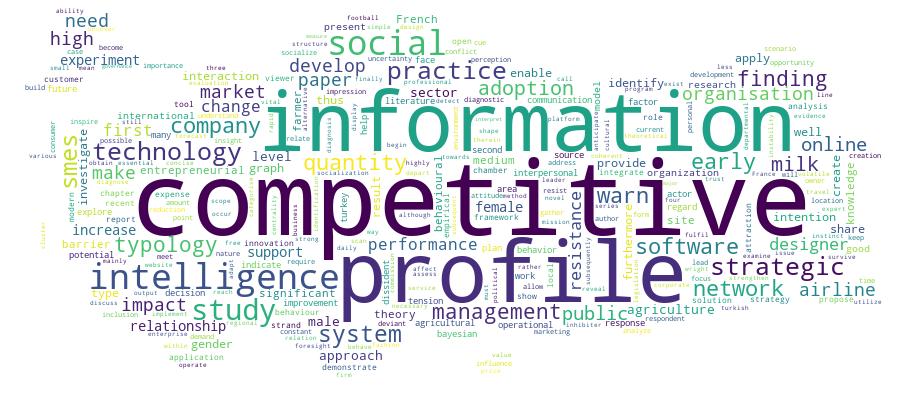
Competency Cloud
21 results
Scholarly Output Search Results
Now showing 1 - 10 of 21
Article Citation - Scopus: 11Exploring Competitive Intelligence Practices of French Local Public Agricultural Organisations(Halmstad University, 2014) Bisson, ChristopheModern agriculture has increased the need for information when making strategic decisions for farmers since they must be more entrepreneurial to survive. This paper investigates the levels of Competitive Intelligence practices in a French Regional Chamber of Agriculture and its four Departmental Chambers of Agriculture to examine the ability of these public organisations to keep fulfilling one of their missions which is to provide the necessary information and knowledge to farmers. Thus this study proposes a behavioural and operational typology of Competitive Intelligence practice. Both types of organisations demonstrate that they are not well adapted to support the entrepreneurial farmers on this issue. The findings of this study and the diagnosis of the Competitive Intelligence practices applied to the typology could be of help to increase their and other public agricultural structures performance levels. Furthermore the platform has the potential to inspire the public sector through subsequent adaptations.Article Citation - WoS: 1Citation - Scopus: 3When Sharing Less Means More: How Gender Moderates the Impact of Quantity of Information Shared in a Social Network Profile on Profile Viewers' Intentions About Socialization(Routledge, 2014) Baruh, Lemi; Chisik, Yoram; Bisson, Christophe; Şenova, BaşakThis study summarizes the results from a 2 (low vs. high information) × 2 (female vs. male profile) experiment that investigates the impact of quantity of information shared on a Social Network Site (SNS) profile on viewers' intentions to pursue further interactions with the profile owner. Quantity of information had no statistically significant effect on intentions to further socialize online. The two-way interaction between information quantity and profile gender was such that for male profiles more information increased profile viewers' intentions to further socialize with the profile owner whereas for female profiles the opposite was the case. The three-way interactions among quantity of information profile gender and profile viewer's gender underline a tendency for male profile viewers to respond more positively to higher information shared by profiles from their own gender. For female viewers this effect although in the same direction was smaller. © 2014 Copyright Eastern Communication Association.Article Citation - WoS: 14Citation - Scopus: 19Strategic Early Warning System for the French Milk Market: a Graph Theoretical Approach To Foresee Volatility(Elsevier, 2017) Bisson, Christophe; Diner, Öznur YaşarThis paper presents a new approach for developing a Strategic Early Warning System aiming to better detect and interpret weak signals. We chose the milk market as a case study in line with the recent call from the EU Commission for governance tools which help to better address such highly volatile markets. Furthermore on the first of April 2015 the new Common Agricultural Policy ended quotas for milk which led to a milk crisis in the EU. Thus we collaborated with milk experts to get their inputs for a new model to analyse the competitive environment. Consequently we constructed graphs to represent the major factors that affect the milk industry and the relationships between them. We obtained several network measures for this social network such as centrality and density. Some factors appear to have the largest major influence on all the other graph elements while others strongly interact in cliques. Any detected changes in any of these factors will automatically impact the others. Therefore scanning ones competitive environment can allow an organisation to get an early warning to help it avoid an issue (as much as possible) and/or seize an opportunity before its competitors. We conclude that Strategic Early Warning Systems as a corporate foresight approach utilising graph theory can strengthen the governance of markets. (C) 2017 Elsevier Ltd. All rights reserved.Article Citation - WoS: 1Citation - Scopus: 2A Bayesian Approach To Developing a Strategic Early Warning System for the French Milk Market(Halmstad University, 2017) Bisson, Christophe; Gürpınar, FurkanA new approach is provided in our paper for creating a strategic early warning system allowing the estimation of the future state of the milk market as scenarios. This is in line with the recent call from the EU commission for tools that help to better address such a highly volatile market. We applied different multivariate time series regression and Bayesian networks on a pre-determined map of relations between macro-economic indicators. The evaluation of our findings with root mean square error (RMSE) performance score enhances the robustness of the prediction model constructed. Our model could be used by competitive intelligence teams to obtain sharper scenarios, leading companies and public organisations to better anticipate market changes and make more robust decisions.Book Part Citation - Scopus: 3First Impressions on Social Network Sites: Impact of Self-Disclosure Breadth on Attraction(Academic Conferences and Publishing International Limited, 2017) Baruh, Lemi; Cemacılar, Zeynep; Bisson, Christophe; Chisik, Yoram I.This paper reports the results of two experiments that investigate the relationship between the quantity of information disclosed on an SNS profile and profile viewers' first impressions of the profile owner. Both experiments utilized a 2 (low quantity of information vs. high quantity of information) by 2 (male vs. female profile) design. In the first experiment (n = 1059), the respondents were randomly assigned to the experimental conditions. The results showed that profile viewers were more favorable to profiles of women. Also, both for female and male SNS profiles, higher quantity of information led to more positive ratings of the profile owner. The second experiment expanded the findings from the first experiment in two ways. First, in the second experiment (n = 320), rather than being randomly assigned to the profile gender condition, the respondents could pick the gender of the profile they would review. Second, informed by previous research on face to face interactions which indicate that quantity of self-disclosure can increase interpersonal attraction by reducing the level of uncertainty about relational outcomes, we tested whether uncertainty reduction mediated the relationship between quantity of information presented in an SNS profile and interpersonal attraction. Female profiles were selected more often than male profiles by both female and male respondents; however, there was no difference in interpersonal attraction ratings that male and female profiles received. Higher quantity of information presented in an SNS profile had a significant impact on interpersonal attraction. The results from the second experiment also indicated that while quantity of information positively influenced profile viewers' perceptions regarding the agreeableness of the profile owner, it did not have an impact on viewers' perceptions regarding the dependability of the profile owner. As predicted, the impact of quantity of information on interpersonal attraction was mediated by a reduction in uncertainty levels.Book Part Web Designers, Social E-Value Creation and E-Business Planning: Understanding Resistance from Conflicting Demands(IGI Global, 2012) Kervenoael, R.D.; Bisson, C.; Palmer, M.This chapter investigates the conflicting demands faced by web designers in the development of social e-atmospherics that aim to encourage e-value creation, thus strengthening and prolonging market planning strategies. While recent studies have shown that significant shifts are occurring concerning the importance of users’ generated content by way of social e-communication tools (e.g. blogs), these trends are also creating expectations that social and cultural cues ought to become a greater part of e-atmospherics and e-business strategies. Yet, there is growing evidence that organizations are resisting such efforts, fearing that they will lose control of their e-marketing strategy. This chapter contributes to the theory and literature on online cross-cultural understanding and the impact website designers (mesolevel) can have on improving the sustainability of e-business planning, departing from recent studies that focus mainly on firms’ e-business plans (macro-level) or final consumers (micro-level). A second contribution is made with respect to online behavior regarding the advancement of technologies that facilitate the development and shaping of new social e-atmospherics that affect users’ behavior and long term e-business strategies through the avoidance of traditional, formal decision making processes and marketing strategy mechanisms implemented by firms. These issues have been highlighted in the literature on the co-production and co-creation of value, which few organizations have thus far integrated in their strategic and pragmatic e-business plans. Drawing upon fifteen online interviews with web designers in the USA, as key non-institutional actors at the meso-level who are developing what future websites will be like, this chapter analyzes ways in which identifying points of resistance and conflicting demands can lead to engagement with the debate over the online co-creation of value and more sustainable future e-business planning. A number of points of resistance to the inclusion of more e-social atmospherics are identified, and the implications for web designers’ roles and web design planning are discussed along with the limitations of the study and potential future research for e-business studies. © 2012 by IGI Global.Conference Object An Illustration of 'strategic Early Warning System' Software and Its Use as a Decision-Making Aid for Professional Football (soccer) Clubs(Destech Publications, 2014) Bisson, Christophe; Büyüktürk, BoraAll economic sectors under the influence of globalization deregulation and growth of Information Technology and Communication are in constant change face a fiercer competition and 'big data'. One solution to address these phenomena is the Strategic Early Warning System. A method of the Strategic Early Warning System and its related software have been developed by Christophe Bisson. This paper shows the importance of the created software through the case of the strategic management of professional football (soccer) teams. Thus a simulation was done for calculating the impacting potential strategic scenarios and their actual impacts. Therein any organization could integrate this 'Strategic Early Warning System' software as a decision system support to anticipate events rather than reacting to them act faster and better than competitors.Book Part Are Web Designers Resisting the Inclusion of Social Cues When Creating Website's User Interface?(IGI Global, 2011) De Kervenoael, Ronan; Bisson, Christophe; Mark Palmer, MarkUsing the resistance literature as an underpinning theoretical framework this chapter analyzes how Web designers through their daily practices (i) adopt recursive adaptive and resisting behavior regarding the inclusion of social cues online and (ii) shape the socio-technical power relationship between designers and other stakeholders. Five vignettes in the form of case studies with expert individual Web designers are used. Findings point out at three types of emerging resistance namely: market driven resistance ideological resistance and functional resistance. In addition a series of propositions are provided linking the various themes. Furthermore the authors suggest that stratification in Web designers' type is occurring and that resistance offers a novel lens to analyze the debate. © 2012 IGI Global.Article Citation - WoS: 9Exploring Competitive Intelligence Practices of French Local Public Agricultural Organisations(Halmstad Univ, Sweden, 2014) Bisson, ChristopheModern agriculture has increased the need for information when making strategic decisions for farmers since they must be more entrepreneurial to survive. This paper investigates the levels of Competitive Intelligence practices in a French Regional Chamber of Agriculture and its four Departmental Chambers of Agriculture to examine the ability of these public organisations to keep fulfilling one of their missions which is to provide the necessary information and knowledge to farmers. Thus, this study proposes a behavioural and operational typology of Competitive Intelligence practice. Both types of organisations demonstrate that they are not well adapted to support the entrepreneurial farmers on this issue. The findings of this study and the diagnosis of the Competitive Intelligence practices applied to the typology could be of help to increase their and other public agricultural structures performance levels. Furthermore, the platform has the potential to inspire the public sector through subsequent adaptations.Master Thesis Comparison of Open Source Customer Relitionship Management Software for Small(Kadir Has Üniversitesi, 2011) Yılmaz, Erturk; Bisson, ChristopheOrganizations have to manage their customer relationship by a more measurable and observable way if they want to face the changing nature of customers. Thus CRM has become a compulsory for companies to prosper. Yet in order to satisfy customers to keep them loyal and retrieve information about them the use of dedicated software has become a necessity. SMEs are the most important organizations in every economy. in spite of the fact that CRM is an obligation for them as well to develop and implement a CRM in such organizations is difficult as they lack budget. Therein open source software is a potential solution. However one can deem this type of software as solutions for specialists. Therefore SMEs have a strong need of guidance as they often lack expertise regarding open source software. in this study a new method to evaluate software is proposed. Yet it is applied to evaluate the top 10 open source CRM software which constitutes a useful tool for SMEs to select the best solution which match their needs.

- «
- 1 (current)
- 2
- 3
- »