
Ayağ, Zeki
Loading...

Profile URL
Name Variants
Ayağ, Zeki
Z.,Ayağ
Z. Ayağ
Zeki, Ayağ
Ayag, Zeki
Z.,Ayag
Z. Ayag
Zeki, Ayag
Ayağ,Z.
Zeki Ayağ
Z.,Ayağ
Z. Ayağ
Zeki, Ayağ
Ayag, Zeki
Z.,Ayag
Z. Ayag
Zeki, Ayag
Ayağ,Z.
Zeki Ayağ
Job Title
Prof. Dr.
Email Address
Main Affiliation
Industrial Engineering
Status
Former Staff
Website
ORCID ID
Scopus Author ID
Turkish CoHE Profile ID
Google Scholar ID
WoS Researcher ID
Sustainable Development Goals
 1
1NO POVERTY
0
Research Products
 2
2ZERO HUNGER
0
Research Products
 3
3GOOD HEALTH AND WELL-BEING
0
Research Products
 4
4QUALITY EDUCATION
0
Research Products
 5
5GENDER EQUALITY
0
Research Products
 6
6CLEAN WATER AND SANITATION
0
Research Products
 7
7AFFORDABLE AND CLEAN ENERGY
6
Research Products
 8
8DECENT WORK AND ECONOMIC GROWTH
2
Research Products
 9
9INDUSTRY, INNOVATION AND INFRASTRUCTURE
8
Research Products
 10
10REDUCED INEQUALITIES
0
Research Products
 11
11SUSTAINABLE CITIES AND COMMUNITIES
0
Research Products
 12
12RESPONSIBLE CONSUMPTION AND PRODUCTION
0
Research Products
 13
13CLIMATE ACTION
0
Research Products
 14
14LIFE BELOW WATER
0
Research Products
 15
15LIFE ON LAND
0
Research Products
 16
16PEACE, JUSTICE AND STRONG INSTITUTIONS
0
Research Products
 17
17PARTNERSHIPS FOR THE GOALS
0
Research Products

This researcher does not have a Scopus ID.

This researcher does not have a WoS ID.

Scholarly Output
45
Articles
31
Views / Downloads
369/5045
Supervised MSc Theses
5
Supervised PhD Theses
1
WoS Citation Count
1030
Scopus Citation Count
1488
Patents
0
Projects
0
WoS Citations per Publication
22.89
Scopus Citations per Publication
33.07
Open Access Source
22
Supervised Theses
6
| Journal | Count |
|---|---|
| Journal of Intelligent & Fuzzy Systems | 5 |
| Journal of Intelligent Manufacturing | 5 |
| International Journal of Energy Sector Management | 2 |
| International Journal of Intelligent Computing and Cybernetics | 2 |
| IIE Annual Conference and Expo 2010 Proceedings -- IIE Annual Conference and Expo 2010 -- 5 June 2010 through 9 June 2010 -- Cancun -- 104967 | 2 |
Current Page: 1 / 6
Scopus Quartile Distribution
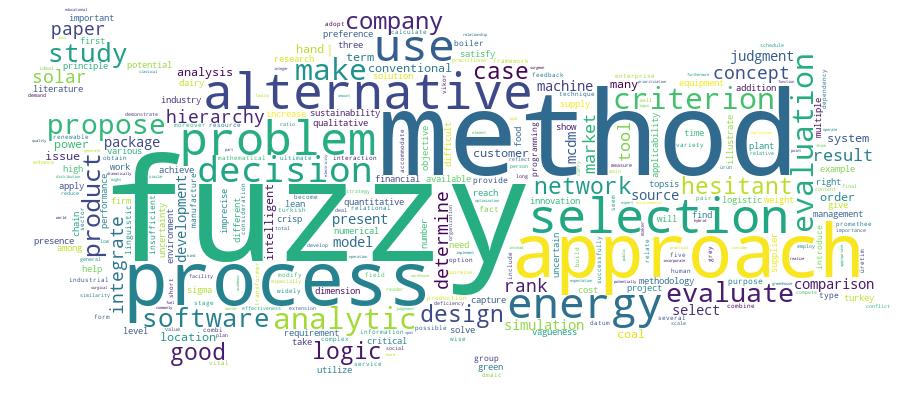
Competency Cloud
45 results
Scholarly Output Search Results
Now showing 1 - 10 of 45
Book Part A Network Model for the Location-Routing Decisions of a Logistics Company(Institute of Industrial Engineers, 2012) Sama, Funda; Yücekaya, Ahmet; Ayağ, Zeki; Samanlioglu, FundaIn this paper, part of the logistics network of one of the leading logistics companies in Turkey is analyzed. Data related to the candidate warehouse locations, supplies and demands of customers are collected. A network model is developed in order to reconfigure the logistics network. The aim of the mathematical model is to help decision makers decide on the locations of warehouses, as well as routing products from suppliers to the distribution center; from distribution center to warehouses; and finally from warehouses to customers. The mathematical model is solved optimally with LINGO solver, and the comparison of the current network with the optimal solution revealed that the overall operating costs can be reduced by approximately 7%.Master Thesis Six Sigma Project Evaluation Under Fuzziness in Food Industry(Kadir Has Üniversitesi, 2013) Şentürk, Özlenen; Ayağ, Zeki; Kahraman, CengizModern-day business world is under constant development at production and service market. Common purpose is to return profit by optimizing costs and raise customer satisfaction to maintain acquired success. It is observed at processes that more service and production are provided by less work force. In food sector which is one of the best known service and production areas, if there will be a new production system "knowledge" should be used as base. On the other hand it is necessary to focus on food safety and customer satisfaction. It is obvious that Six Sigma approach is helpful to achieve this tradition. Statistically objective is to enhance performance at processes by reaching defect margin of 3,4 units at 1 million product or service. Six Sigma methodology provides cultural exchange on the way to improvement. Companies can do measurements by using quality control tools for topics like determining cost expenses. However these companies will have difficulties measuring customer satisfaction. Especially at food sector, performing measurements mostly brings along difficulties due to variable customer needs. In this connection it will be an important attempt to use "Fuzzy Logic". Fuzzy Logic is an artificial intelligence principle with variable outcomes which does not gives certain results like classic logic and datas are estimated. In this research, most suitable alternative and method is determined by Six Sigma project evaluation approach under Fuzzy Logic for 5 different selected food facilities in Turkey.Article Citation - WoS: 1Citation - Scopus: 3An Approach To Evaluate Cam Software Alternatives(TAYLOR & FRANCIS LTD, 2020) Ayağ, ZekiThe selection process for the best computer-aided manufacturing (CAM) software among a set of potential number of alternatives in market has been critical issue for most companies that aim to make their design/manufacturing-related activities automated. Because this selection process is very vital for companies because a wrong decision might put them into a difficult position in terms of economical, market share and time spent. Therefore, today's companies have used different multiple-criteria decision making (MCDM) methods for the evaluation study of CAM software alternatives to make this complex process easily applicable and not time-consuming. Among the MCDM methods in literature, the analytic hierarchy process (AHP) method has been widely used for various MCDM problems in both academic researches and industrial practices. However, in some cases, because of the vagueness and uncertainty on the judgments of decision maker(s), the crisp pair wise comparison in the conventional AHP seems to be insufficient and imprecise to capture the right judgments of decision maker(s). Therefore, a fuzzy logic method is integrated in the pair wise comparison of AHP to make up for this deficiency in the conventional AHP, called as fuzzy AHP. Moreover, the proposed approach is also realized on a case study.Article Citation - WoS: 45Citation - Scopus: 59A Hybrid Approach To Machine-Tool Selection Through Ahp and Simulation(Taylor & Francis, 2007) Ayağ, ZekiThe selection process of a machine tool has been a critical issue for companies for years because the improper selection of a machine tool might cause many problems having a negative effect on productivity precision flexibility and a company's responsive manufacturing capabilities. Therefore in this paper to determine the best machine tool satisfying the needs and expectations of a manufacturing organization among a set of possible alternatives in the market a hybrid approach is proposed which integrates an analytic hierarchy process (AHP) with simulation techniques. The AHP as one of the most commonly used multiple criteria decision-making methods is used to narrow down all possible machine tool alternatives in the market by eliminating those whose scores (or weights) are smaller than a determined value obtained under certain circumstances. Then a simulation generator is used first to automatically model a manufacturing organization where the ultimate machine tool will be used and second to try each alternative remaining from the AHP as a scenario on the generated model. Finally the final alternative is selected by using the unit investment cost ratio which is calculated by dividing the investment cost per year of each alternative by the additional number of produced units obtained from the simulation experiment of the relevant alternative.Conference Object Citation - WoS: 4A Multiple-Criteria Decision Making Method for Evaluating Solar Power Plant Location Alternatives(EDITURA ASE, 2015) Ayağ, ZekiSolar energy is the most readily available source of energy and one of the most important sources of the renewable energy because it is non-polluting and helps in lessening the greenhouse effect. Main problem of establishing a solar power plant is to determine its location. In the presence of many location alternatives and evaluation criteria a multiple-criteria decision making problem arises. In this work the location problem will be solved by using analytic hierarchy process (AHP) to figure out the most satisfying alternative. A numerical example is also included to show the proposed methodology in Turkey.Article Citation - WoS: 19Citation - Scopus: 23A Comparison Study of Fuzzy-Based Multiple-Criteria Decision-Making Methods To Evaluating Green Concept Alternatives in a New Product Development Environment(EMERALD GROUP PUBLISHING LTD, 2021) Ayağ, ZekiPurpose In this paper, the four popular multiple-criteria decision-making (MCDM) methods in fuzzy environment are utilized to reflect the vagueness and uncertainty on the judgments of decision-makers (DMs), because the crisp pairwise comparison in these conventional MCDM methods seems to be insufficient and imprecise to capture the right judgments of DMs. Of these methods, as Fuzzy analytic hierarchy process (F-AHP) is used to calculate criteria weights, the other methods; Fuzzy Technique for Order of Preference by Similarity to Ideal Solution (F-TOPSIS), Fuzzy Grey relational analysis (F-GRA) and Fuzzy Preference Ranking Organization METhod for Enrichment of Evaluations (F- PROMETHEE II) are used to rank alternatives in the three different ways for a comparative study. Design/methodology/approach The demand for green products has dramatically increased because the importance and public awareness of the preservation of natural environment was taken into consideration much more in the last two decades. As a result of this, especially manufacturing companies have been forced to design more green products, resulting in a problem of how they incorporate environmental issues into their design and evaluate concept options. The need for the practical decision-making tools to address this problem is rapidly evolving since the problem turns into an MCDM problem in the presence of a set of green concept alternatives and criteria. Findings The incorporation of fuzzy set theory into these methods is discussed on a real-life case study, and a comparative analysis is done by using its numerical results in which the three fuzzy-based methods reveal the same outcomes (or rankings), while F-GRA requires less computational steps. Moreover, more detailed analyses on the numerical results of the case study are completed on the normalization methods, distance metrics, aggregation functions, defuzzification methods and other issues. Research limitations/implications The designing and manufacturing environmental-friendly products in a product design process has been a vital issue for many companies which take care of reflecting environmental issues into their product design and meeting standards of recent green guidelines. These companies have utilized these guidelines by following special procedures at the design phase. Along the design process consisting of various steps, the environmental issues have been considered an important factor in the end-of-life of products since it can reduce the impact on the nature. In the stage of developing a new product with the aim of environmental-friendly design, the green thinking should be incorporated as early as possible in the process. Practical implications The case study was inspired from the previous work of the author, which was realized in a hot runner systems manufacturer, used in injection molding systems in a Canada. In a new product development process, the back- and front-ends of development efforts mainly determine the following criteria: cost, risk, quality and green used in this paper. The case study showed that the three fuzzy MCDM methods come to the same ranking outcomes. F-GRA has a better time complexity compared to the other two methods and uses a smaller number of computational steps. Moreover, a comparative analysis of the three F-MCDM methods; F-PROMETHEE II, F-TOPSIS and F-GRA used in ranking for green concept alternatives using the numerical results of the case study. For the case study; as seen in table 20, the three F-MCDM methods produced the numerical results on the rankings of the green concept alternatives as follows; {Concept A-Concept C-Concept B-Concept D}. Social implications Inclusion of environmental-related criteria into concept selection problem has been gaining increasing importance in the last decade. Therefore, to facilitate necessary calculations in applying each method especially with its fuzzy extension, it can be developed a knowledge-based (KB) or an expert system (ES) to help the DMs make the required calculations of each method, and interpret its results with detailed analysis. Originality/value The objective of the research was to propose a F-AHP based F-MCDM approach to green concept selection problem through F-PROMETHEE II, F-TOPSIS and F-GRA methods. As the F-AHP is used to weight evaluation criteria, the other methods are respectively used for ranking the concept alternatives and determine the best concept alternative.Master Thesis Designing of an Enterprise Product Innovation System for Companies(Kadir Has Üniversitesi, 2018) Demirhan, Mehmet Özhan; Ayağ, ZekiToday, innovation is the most decisive factor for companies to grow and gain competitive edge in the market. In particular, firms support a product innovation policy in order to be permanent in the market. Product innovation refers to the emergence of new products and the development of existing products. By means of companies' product innovation reduces expenditure; new customers win and make high profits. AHP Method with a numerical example to evaluate the projects in this system. Organizational, technical, strategic and financial criteria have been examined. In the selection of the projects, companies have given much importance to the financial and organizational criteria. This research is expected to be very useful for evaluating and selecting projects for companies.Master Thesis A Fuzzy Ahp Approach for Financial Performance Evaluation Airline Companies(Kadir Has Üniversitesi, 2012) Gürel, Sinem; Ayağ, ZekiPrevious researches focused on operation performance. This thesis purposes for evaluating the financial performance of the airlines. In order to achieve financial objectives to be incorporated into the financial performance of their degree. It is a method to measure the results of a company?s operations in a monetary term. The problem is modeled by multi-criteria decision making (MCDM) one. Multi criteria decision making (MCDM) is a method of the most important fields of operations research and deals with the problems that include multiple and conflicting objectives. It is obvious that when more than objective exists in the problem, making a decision becomes more complex. To solve the problem, I used the fuzzy numbers to explain their values. After that, I used a method of fuzzy multi criteria group decision making (FMCGDM) as Fuzzy Analytic Hierarchy Process (FAHP) to solve the problem of the evaluation of airlines? financial performances. At first time the decision making process of the financial performance is investigated, when financial ratios are given by a fuzzy function, they are obtained through classical methods. After that, we will discuss the main advantages of the new approach. Finally, we illustrate an experimantal model of evaluation of the three domestic airlines? financial performance in Turkey.Article Citation - Scopus: 2Cad Software Evaluation for Product Design To Exchange Data in a Supply Chain Network(ExcelingTech Publishers, 2015) Ayağ, ZekiThe sharing information in a supply chain environment especially CAD models and drawings are so important companies. So the selection of the most satisfying computer-aided design (CAD) software which enables to exchange data through supply chain network has been major issues for companies in a supply chain. The selection process of CAD software among the raising number of alternatives in the market has been very vital and critical issue for companies that aim to make their design and engineering related activities automated towards computer integrated manufacturing (CIM) environment. Therefore most companies have used various methods to successfully carry out this difficult and time-consuming process. Of these methods Analytic Hierarchy Process (AHP) has been widely used for Multiple Criteria Decision Making (MCDM) problems in both academic researches and practices. But in some cases due to the vagueness and uncertainty on judgments of the decisionmaker(s) the crisp pair wise comparison in the conventional AHP seems to be insufficient and imprecise to capture the right judgments of decision-maker(s). Therefore a fuzzy logic is introduced in the pair wise comparison of AHP to make up for this deficiency in the conventional AHP called as fuzzy AHP. In this paper a fuzzy AHP-based approach is proposed to evaluate a set of CAD software alternatives in the market to reach the best satisfying one based on the needs of company. © ExcelingTech Pub UK.Article Citation - Scopus: 3An Intelligent Approach To Evaluating Cad Software Packages Through Hesitant Fuzzy Ahp(World Scientific Publ Co Pte Ltd, 2022) Ayag, ZekiThe evaluation of computer-aided design (CAD) packages among the rising number of alternatives in the market has been a critical process for companies because it directly affects the performance of their design/engineering-related activities in a new product development (NPD) as well as in R&D departments. Moreover, it is seen as an important step towards the computer-integrated manufacturing (CIM) environment. On the other hand, the evaluation process of CAD software packages is a multiple-criteria decision-making (MCDM) problem in the presence of sets of alternatives and evaluation criteria, which should be solved using one of the MCDM methods in the current literature. Therefore, in this study, the analytic hierarchy process (AHP), successfully implemented in both academic research and practices, is used for CAD software selection problem. The method is also used with the group decision-making approach to reach a more reliable solution. Additionally, due to the fact that the crisp pairwise comparison in the traditional AHP method seems to be insufficient and imprecise to capture the right judgments of decision makers (DMs), the hesitant fuzzy linguistic term-sets are integrated with the AHP approach (the hesitant F-AHP) to model the vagueness and uncertainty on judgments of the DMs. This proposed approach is also supported with a user-friendly Excel template that provides an effective tool for companies to evaluate and rank CAD software packages without many tiresome fuzzy comparisons and complex calculations. Moreover, in the paper, a numerical example is presented to demonstrate the effectiveness and applicability of the proposed approach to potential readers and practitioners. In this example, five CAD software options are evaluated based on six criteria by three DMs; and the best alternative is determined.
