
Görçün, Ömer Faruk
Loading...

Profile URL
Name Variants
Görçün, Ö.
Görçün,Ö.F.
GÖRÇÜN, Ömer Faruk
Omer Faruk Görçün
Görçün, Ö. F.
GÖRÇÜN, ÖMER FARUK
Ömer Faruk Görçün
ÖMER FARUK GÖRÇÜN
Faruk Görçün Ö.
Gorcun, Omer Faruk
Görçün, ÖMER FARUK
Ö. Görçün
G.,Omer Faruk
Gorcun,Ö.F.
Görçün, Omer Faruk
Görçün O.
Ö. F. Görçün
Ömer Faruk GÖRÇÜN
Gorcun,Omer Faruk
Görçün Ö.
Gorcun,O.F.
Gorcun O.
Görçün, O.
G., Ömer Faruk
Omer Faruk, Gorcun
G., Omer Faruk
O. Görçün
Görçün, Ömer Faruk
Faruk Görçün,Ö.
Goercuen, oemer Faruk
Görçün, Ö.F.
Gorcuen, Omer Faruk
Faruk Görçün, Ömer
Faruk Görçün, Ö.F.
Görçün,Ö.F.
GÖRÇÜN, Ömer Faruk
Omer Faruk Görçün
Görçün, Ö. F.
GÖRÇÜN, ÖMER FARUK
Ömer Faruk Görçün
ÖMER FARUK GÖRÇÜN
Faruk Görçün Ö.
Gorcun, Omer Faruk
Görçün, ÖMER FARUK
Ö. Görçün
G.,Omer Faruk
Gorcun,Ö.F.
Görçün, Omer Faruk
Görçün O.
Ö. F. Görçün
Ömer Faruk GÖRÇÜN
Gorcun,Omer Faruk
Görçün Ö.
Gorcun,O.F.
Gorcun O.
Görçün, O.
G., Ömer Faruk
Omer Faruk, Gorcun
G., Omer Faruk
O. Görçün
Görçün, Ömer Faruk
Faruk Görçün,Ö.
Goercuen, oemer Faruk
Görçün, Ö.F.
Gorcuen, Omer Faruk
Faruk Görçün, Ömer
Faruk Görçün, Ö.F.
Job Title
Dr. Öğr. Üyesi
Email Address
Main Affiliation
Business Administration
Business Administration
01. Kadir Has University
Business Administration
01. Kadir Has University
Status
Current Staff
Website
ORCID ID
Scopus Author ID
Turkish CoHE Profile ID
Google Scholar ID
WoS Researcher ID
Sustainable Development Goals
2
ZERO HUNGER

2
Research Products
3
GOOD HEALTH AND WELL-BEING

3
Research Products
7
AFFORDABLE AND CLEAN ENERGY

7
Research Products
8
DECENT WORK AND ECONOMIC GROWTH

5
Research Products
9
INDUSTRY, INNOVATION AND INFRASTRUCTURE

24
Research Products
10
REDUCED INEQUALITIES

2
Research Products
11
SUSTAINABLE CITIES AND COMMUNITIES

23
Research Products
12
RESPONSIBLE CONSUMPTION AND PRODUCTION

12
Research Products
13
CLIMATE ACTION

8
Research Products
14
LIFE BELOW WATER

9
Research Products
15
LIFE ON LAND

1
Research Products
17
PARTNERSHIPS FOR THE GOALS

15
Research Products

Documents
73
Citations
1223
h-index
20

Documents
65
Citations
1006

Scholarly Output
97
Articles
82
Views / Downloads
480/4554
Supervised MSc Theses
1
Supervised PhD Theses
0
WoS Citation Count
903
Scopus Citation Count
1123
WoS h-index
19
Scopus h-index
20
Patents
0
Projects
0
WoS Citations per Publication
9.31
Scopus Citations per Publication
11.58
Open Access Source
35
Supervised Theses
1
Google Analytics Visitor Traffic
| Journal | Count |
|---|---|
| Engineering Applications of Artificial Intelligence | 9 |
| Expert Systems with Applications | 4 |
| Accounting, Finance, Sustainability, Governance and Fraud | 4 |
| Kybernetes | 3 |
| Journal of Cleaner Production | 3 |
Current Page: 1 / 13
Scopus Quartile Distribution
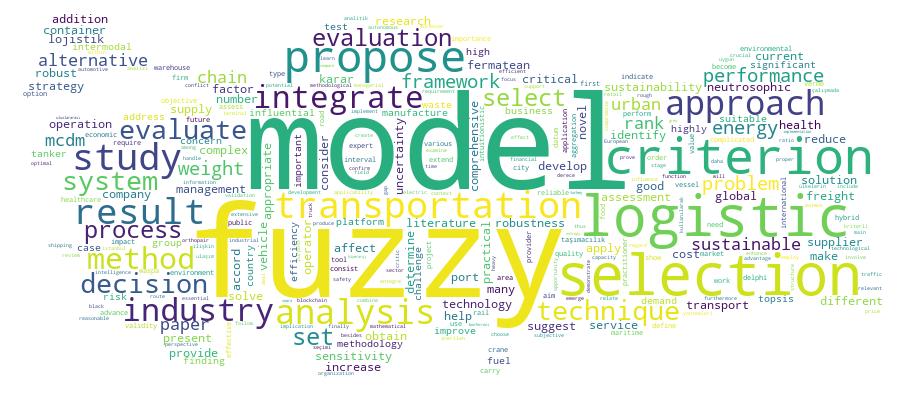
Competency Cloud
Scholarly Output Search Results
Now showing 1 - 10 of 97
Article Liman Seçim Problemi İçin Entegre Bulanık Çok Kriterli Karar Verme Yaklaşımı Önerisi(2023) Küçükönder, Hande; Görçün, Ömer FarukLiman seçimi denizcilik işletmelerinin yanı sıra, tedarik zincirlerinin performansı açısından son derece önemli kararlardan birisidir. Ancak liman alternatiflerinin değerlendirilebilmesi için her zaman net veri mevcut olmayabilir ve karar vericiler eksik bilgiler ile belirsizlik ortamında karar vermek zorunda kalabilir. Bu kapsamda mevcut çalışmada en uygun limanların seçilebilmesi için belirsizlikleri dikkate alabilen bulanık SWARA ve bulanık MARCOS yöntemlerinden oluşan entegre bir karar verme yaklaşımı önerilmektedir. Önerilen yaklaşım uygulandıktan sonra 70 farklı senaryo oluşturularak kapsamlı bir doğrulama testi gerçekleştirilmiştir. Elde edilen sonuçlara göre bazı alternatiflerin sıralama skorlarında genel sonucu değiştirmeyen küçük farklılıklar görülmekle birlikte Al alternatifi bütün senaryolar için en iyi alternatif olarak kalmıştır. Sonuç olarak, analizin sonuçları önerilen yaklaşımın karar verme problemlerini çözmek için uygulanabilir bir model olduğunu kanıtlamaktadır.Article Citation - WoS: 15Citation - Scopus: 18Efficiency Analysis Technique With Input and Output Satisficing Approach Based on Type-2 Neutrosophic Fuzzy Sets: a Case Study of Container Shipping Companies(Pergamon-Elsevier Science Ltd, 2023) Zolfani, Sarfaraz Hashemkhani; Gorcun, Omer Faruk; Canakcioglu, Mustafa; Tirkolaee, Erfan BabaeeThis work tries to discuss and evaluate the advantages and superiorities of the extended Efficiency Analysis Technique with Input and Output Satisficing (EATWIOS) method based on Type-2 Neutrosophic Fuzzy Numbers (T2NFNs). The suggested model is maximally stable and robust by considering sensitivity analysis results which demonstrates a new performance analysis approach based on T2NFN sets. The proposed model deals with the input and output criteria and considers existing uncertainties arising from insufficient information and the dy-namic structure of the industries. The model's basic algorithm has a unique structure compared to the previous performance analysis technique, and it does not require applying additional weighting techniques to identify the criteria weights. To the best of our knowledge, the extended version of the EATWIOS technique based on the T2NFN set is presented for the first time. The developed model provides reasonable and logical results to practitioners because it deals with satisfactory outputs instead of optimal outputs. This model is an immensely strengthened version of the EATWIOS technique, as the T2NFN sets treat predictable and unpredictable un-certainties. The suggested T2NFN-EATWIOS is then applied to a real-world assessment problem in the container shipping industry. The obtained results are pretty reasonable and logical. Moreover, the results of a compre-hensive sensitivity analysis with three stages approve the robustness of the suggested model.Article Citation - Scopus: 6Foreign Market Selection of Suppliers Through a Novel Ref-Sort Technique(Emerald Publishing, 2023) Aytekin,A.; Görçün,Ö.F.; Ecer,F.; Pamucar,D.; Karamaşa,Ç.Purpose: The present study aims to provide a practical and robust assessment technique for assessing countries' investability in global supply chains to practitioners. Thus, the proposed approach can help decision-makers evaluate and select appropriate countries in the expansion process of the global supply chains and reduce risks concerning country (market) selection. Design/methodology/approach: The present study proposes a novel decision-making approach, namely the REF-Sort technique. The proposed approach has many valuable contributions to the literature. First, it has an efficient basic algorithm and can be applied to solve highly complicated decision-making problems without requiring advanced mathematical knowledge. Besides, some characteristics differentiate REF-Sort apart from other techniques. REF-Sort employs the value or value range that reflects the most typical characteristic of the relevant class in assignment processes. The reference values in REF-Sort and center profiles are similar in this regard. On the other hand, class references can be defined as ranges in REF-Sort. Secondary values, called successors, can also be employed to assign a value to the appropriate class. REF-Sort can also determine the reference and successor values/ranges independently of the decision matrix. In addition, the proposed model is a maximally stable and consistent decision-making tool, as it is resistant to the rank reversal problem. Findings: The current papers' findings indicate that countries have different features concerning investment. Hence, the current paper pointed out that only 22% of the 95 countries are investable, whereas 19% are risky. Thus, decision-makers should make detailed evaluations using robust, powerful, and practical decision-making tools to make more reasonable and logical decisions concerning country selection. Originality/value: The current paper proposes a novel decision-making approach to evaluate. According to the authors' information, the proposed model has been applied to evaluate investable countries for the global supply chains for the first time. © 2022, Emerald Publishing Limited.Article Citation - WoS: 17Citation - Scopus: 18The Selection of Appropriate Ro-Ro Vessel in the Second-Hand Market Using the Waspas' Bonferroni Approach in Type 2 Neutrosophic Fuzzy Environment(Pergamon-Elsevier Science Ltd, 2023) Gorcun, Omer Faruk; Pamucar, Dragan; Krishankumar, Raghunathan; Kucukonder, HandeThe second-hand vessel market has quite different dynamics than the market of the new-building vessel, and highly complicated and conflicting criteria and many uncertainties affect the ship selection process. Therefore, it is required to use a robust mathematical model to solve these kinds of decision-making problems. For this purpose, this paper presents an extended version of WASPAS (Weighted Aggregated Sum Product ASsessment) techniques with the help of T2NN based on the Bonferroni function (T2NN WASPAS'B). The three main focal points of the proposed approach are (i) setting the influential criteria to select the appropriate Ro-Ro vessel in the second-hand vessel market; and (ii) presenting a flexible group decision-making approach, which is proper to real decision-making problems. (iii) detecting the interrelations among criteria and eliminating the negative impacts of undesirable and excessive values in input variables on the results. Practical use of the proposed approach is demonstrated to select the appropriate Ro-Ro vessel in the second-hand market. The analysis results show that the most effective and determinative factor is Trailer Lane length, and the most effective alternative is GREIFSWALD. Besides, the consistency and validity of the obtained results have been verified with the help of a stability and robustness check. The results prove that the proposed novel T2NN WASPAS'B model is robust, powerful, and reliable for making rational and realistic decisions.Article Citation - WoS: 1Productivity Analysis of Black Sea Container Ports by Using Integrated Entropy and Eatwos Methods(Eskısehır Osmangazı Univ, 2019) Görçün, Ömer FarukThe Black Sea region is an extremely important region for global trade. Approaches such as short sea shipping and marine highways, which are on the agenda of European Union lead to increase the importance of Black Sea container ports by day by. Thus, performance of seaports of the region will be important factors, which can affect to their development and improvement that will be happened. Because effectivity of seaports may be effected by many factors, it is needed to use the MCDM methodologies can provide a systematic and structural solution way for evaluation. In this study, a hybrid model, which integrated the entropy and EATWOS methods is proposed to make productivity analysis of Black sea container ports. It is expected that obtained results from this study may have a usable characteristic by investors and public authorities in addition to actors, that placed in the logistics processesArticle Citation - Scopus: 16An Integrated Mcdm Approach for Evaluating the Ro-Ro Marine Port Selection Process: a Case Study in Black Sea Region(Routledge, 2021) Görçün, Ömer Faruk; Küçükönder, HandeSelection of the appropriate Roll-on Roll-off (Ro-Ro) port is one of the crucial tasks for the maritime industry. Because there are many factors affecting the selection process, this selection process is essentially a multi-criteria decision-making problem. This paper proposes a integrated approach consisting of the CRITIC (Criteria Importance Through Intercriteria Correlation) technique and the EDAS (Evaluation based on Distance from Average Solution) method to evaluate the Ro-Ro marine ports selection. The obtained results by using the proposed model have been verified carrying out a comprehensive sensitivity analysis. In accordance with this purpose, 10 different scenarios were established and five MCDM methods were applied to make a comparison. Results obtained using the suggested model were verified in dynamic conditions. The main purpose of this implementation is to determine whether any change in the obtained results for each determined scenario. Carried out sensitivity analysis shows that the suggested hybrid MCDM model consisting of CRITIC and EDAS techniques has validity and the obtained results are accurate and realistic. When the results of the sensitivity analysis are reviewed, it can be seen that the P1 option is the best alternative for all scenarios.Article Citation - WoS: 6Foreign Market Selection of Suppliers Through a Novel Ref-Sort Technique(Emerald Group Publishing Ltd, 2022) Aytekin, Ahmet; Gorcun, Omer Faruk; Ecer, Fatih; Pamucar, Dragan; Karamasa, CaglarPurpose The present study aims to provide a practical and robust assessment technique for assessing countries' investability in global supply chains to practitioners. Thus, the proposed approach can help decision-makers evaluate and select appropriate countries in the expansion process of the global supply chains and reduce risks concerning country (market) selection. Design/methodology/approach The present study proposes a novel decision-making approach, namely the REF-Sort technique. The proposed approach has many valuable contributions to the literature. First, it has an efficient basic algorithm and can be applied to solve highly complicated decision-making problems without requiring advanced mathematical knowledge. Besides, some characteristics differentiate REF-Sort apart from other techniques. REF-Sort employs the value or value range that reflects the most typical characteristic of the relevant class in assignment processes. The reference values in REF-Sort and center profiles are similar in this regard. On the other hand, class references can be defined as ranges in REF-Sort. Secondary values, called successors, can also be employed to assign a value to the appropriate class. REF-Sort can also determine the reference and successor values/ranges independently of the decision matrix. In addition, the proposed model is a maximally stable and consistent decision-making tool, as it is resistant to the rank reversal problem. Findings The current papers' findings indicate that countries have different features concerning investment. Hence, the current paper pointed out that only 22% of the 95 countries are investable, whereas 19% are risky. Thus, decision-makers should make detailed evaluations using robust, powerful, and practical decision-making tools to make more reasonable and logical decisions concerning country selection. Originality/value The current paper proposes a novel decision-making approach to evaluate. According to the authors' information, the proposed model has been applied to evaluate investable countries for the global supply chains for the first time.Article Citation - Scopus: 1A Novel Performance Evaluation Technique Based on Integrated Weighting Approach: A Case Study in the Field of Sport Management(Growing Science, 2021) Gorcun, Omer Faruk; Kucukonder, HandeIt is a fact accepted by everybody that football is the most popular sport around the world. The result of a derby match may be very important for millions of people. Even the time seems to stop on a match day for so many people. Show and entertainment are the most important aspects of football. If soccer players have a high performance, a match may provide pleasure and excitement to audiences. Briefly, the performance and quality of soccer players are the key factors, which draw audiences. Goalkeepers are also one of the important components of football like other players playing different positions such as strikers, mid-fielders, and defenders. Moreover, a goalkeeper can affect the result of a match positively or negatively. Therefore, with the help of a mathematical approach as the methodological framework, it can be seen that the examination of the performance of goalkeepers can be beneficial for decision-makers performing in the fields of sport and the future studies. The current paper proposes an improved integrated multi-criteria decision-making approach to evaluate the selection of goalkeepers; and this model can be applied for goalkeeper's performance analysis. The proposed model combines the weights of criteria calculated with the help of both the CRITIC and the PSI techniques by applying the weight aggregation operator. It also ranks the decision alternatives by implementing the WASPAS technique based on the final criteria weights obtained by using the weight aggregation operator. In addition, a comprehensive sensitivity analysis consisting of three stages was performed to verify the validation of the suggested hybrid model. It has been observed that All has remained the best option for all scenarios. As a result, the results of the sensitivity analysis prove that the proposed hybrid MCDM technique is a very useful, strong and applicable approach. Also, the results obtained by applying the proposed model are accurate, realistic, and reasonable according to the results of the validation test. (C) 2021 by the authors; licensee Growing Science, Canada.Article ARAŞTIRMA GELİŞTİRME HARCAMALARININ G-7 ÜLKELERİNİN GELİŞMİŞLİK DÜZEYİNE ETKİLERİNİN İNCELENMESİ: YENİ BİR KARAR MODELİ(2022) Çanakçıoğlu, Mustafa; Görçün, Ömer Faruk; Küçükönder, HandeGünümüzde ülkelerin gelişmişlik düzeyinin önde gelen göstergelerinden biri de inovasyon yeteneği yani yeni ürün geliştirme yeteneğidir. Böylece ülkeler küresel rekabet ortamında katma değeri ve toplumsal refahlarını artırmak için ürün ve teknoloji geliştirme yeteneklerini hızla geliştirmeye yönelmişlerdir. Ancak araştırma ve geliştirme (Ar-Ge) için yapılan harcamalar her zaman katma değer yaratan yeni ürünlerin üretilmesiyle sonuçlanamamaktadır. Maliyetin yüksek olmasına neden olduğu için özel sektör yatırım ve Ar-Ge harcamalarında çekingen davranabilmekte ve doğrudan görece düşük katma değere sahip kısa vadeli yatırımlar ve Ar-Ge harcamaları yapmaktadır. Bu koşullar altında ülkelerin yeni ve teknolojik ürünler üretebilmeleri, Ar-Ge maliyetlerini büyük ölçüde kamu otoritelerinin üstlenmesine bağlıdır. Ancak Ar-Ge harcamaları kamu bütçesine ağır bir yük getirmekte ve çok büyük miktarda kamu kaynağının harcanmasına neden olabilmektedir. Bu açıdan Ar-Ge harcamalarının ülkelerin bu konudaki hedeflerine olan etkilerinin gerçekçi bir bakış açısıyla ölçülmesi, analiz edilmesi ve değerlendirilmesi gerekmektedir. Bu nedenle, ülkelerin yeni ve teknolojik ürün üretme kabiliyetine ilişkin performanslarını kamu kaynak kullanımını dikkate alarak ölçmek için pratik, uygulanabilir ve iyi sonuçlar verebilecek bir metodolojik çerçeveye ihtiyaç duyulmaktadır. Ayrıca yazarlar tarafından yapılan kapsamlı bir ön araştırma sonucunda mevcut literatürde ciddi ve önemli boşluklar tespit edilmiştir. İlk olarak, yazarların bilgisine göre, ülkelerin Ar-Ge performanslarını ele alan çalışmaların sayısı dışında karşılaştırmalı analiz sağlayan bir çalışma yok denecek kadar azdır. Yakın çalışmaların çoğu bazı sınırlamaları ve yapısal sorunları olmasına rağmen Veri Zarflama yöntemi (VZA) yaklaşımını uygulamayı tercih etti ve sağlam bir metodolojik çerçeve önermediler. Ayrıca daha önce yapılan bu çalışmalarda kriterlerin nasıl belirlendiği hakkında bir bilgi bulunmamaktadır. Uygulanan model ve kriterlerin güvenilirliği konusunda şüphe uyandırmakta ve güvenilir bir değerlendirme ortamı sağlamamaktadır. Çalışmanın temel motivasyonu, bu boşlukları ve gereksinimleri göz önünde bulundurarak objektif ve sağlam bir entegre karar verme modeli önermektir. Ayrıca kamu otoritelerinde, kurumlarda ve bireylerde güçlü bir motivasyon vardır. Mevcut makale, kamu otoriteleri tarafından Ar-Ge harcamaları için elde edilen çıktıları analiz etmek için matematiksel bir operatör yardımıyla Entropi ve CRITIC teknikleri ile birleştirilmiş ağırlıklandırma sistemine dayalı EATWOS tekniğinin kullanılmasını önermektedir. Önerilen çerçeve, ülkelerin Ar-Ge harcamalarının ülkelerin yenilikçilik yeteneği üzerindeki etkilerine ilişkin performanslarını değerlendirmek için uygulandı ve önerilen modelin ve sonuçlarının geçerliliğini ve uygulanabilirliğini test etmek için kapsamlı bir duyarlılık analizi yapıldı. Duyarlılık analizinin sonuçları, önerilen Çok Kriterli Karar Verme (ÇKKV) çerçevesinin geçerliliğini ve uygulanabilirliğini onaylar.Article Citation - WoS: 41Citation - Scopus: 39Evaluation of Third-Party Logistics Service Providers for Car Manufacturing Firms Using a Novel Integrated Grey Lopcow-Psi Model(Pergamon-elsevier Science Ltd, 2024) Ulutas, Alptekin; Topal, Ayse; Gorcun, Omer Faruk; Ecer, FatihAutomotive businesses often delegate logistical tasks to third-party logistics (3PLs) service providers to acquire a competitive edge in the dynamic market. Nevertheless, selecting the most suitable third-party logistics (3PL) partner is a multifaceted undertaking that needs careful evaluation of several criteria and alternatives. This research aims to introduce an integrated grey Multiple Criteria Decision Making (MCDM) framework for automotive businesses to deal with the multidimensional 3PL selection decision problem. This framework incorporates an enhanced Preference Selection Index (PSI), Logarithmic Percentage Change-driven Objective Weighting (LOPCOW), and Mixed Aggregation by Comprehensive Normalization Technique (MACONT). The LOPCOW-G and grey PSI (PSI-G) methods extract the criterion weights, whereas the MACONT-G method ranks the alternatives. The suggested framework's practicality is shown by conducting a case study about evaluating and selecting a third-party logistics (3PLs) provider. The findings indicate that the parameters of significant importance are "skilled workforce (0.0977)," "financial strength (0.0901)," and "IT-IS competence (0.0839)." Furthermore, TPL4 has been recognized as the most optimum option with a value of 0.4797. The MACONT-G model is as well compared against other grey MCDM techniques to assess the validity of the proposed model. The Pearson correlation coefficient between MACONT-G and the other models based on grey sets is 0.958, suggesting a significant and positive link. Furthermore, it is worth noting that a sensitivity analysis has been conducted to validate the accuracy and reliability of the created framework. In conclusion, this study has identified managerial and policy implications that might assist policymakers and executives in effectively evaluating 3PL providers.
