
Ucal, Meltem
Loading...

Profile URL
Name Variants
Meltem, Ucal
Ucal, M.
Ucal,M.
M. Ucal
MELTEM UCAL
Ucal,Meltem
U., Meltem
UCAL, Meltem
UCAL, MELTEM
Ucal, Meltem
U.,Meltem
Ucal, MELTEM
Ucal M.
Meltem UCAL
Meltem Ucal
Ucal, Meltem Şengün
Şengül Ucal, Meltem
Ucal, Meltem Şengün
Şengün Ucal, Meltem
Ucal, M.
Ucal,M.
M. Ucal
MELTEM UCAL
Ucal,Meltem
U., Meltem
UCAL, Meltem
UCAL, MELTEM
Ucal, Meltem
U.,Meltem
Ucal, MELTEM
Ucal M.
Meltem UCAL
Meltem Ucal
Ucal, Meltem Şengün
Şengül Ucal, Meltem
Ucal, Meltem Şengün
Şengün Ucal, Meltem
Job Title
Prof. Dr.
Email Address
Main Affiliation
Economics
Status
Current Staff
Website
ORCID ID
Scopus Author ID
Turkish CoHE Profile ID
Google Scholar ID
WoS Researcher ID
Sustainable Development Goals
 1
1NO POVERTY
6
Research Products
 2
2ZERO HUNGER
3
Research Products
 3
3GOOD HEALTH AND WELL-BEING
0
Research Products
 4
4QUALITY EDUCATION
0
Research Products
 5
5GENDER EQUALITY
3
Research Products
 6
6CLEAN WATER AND SANITATION
0
Research Products
 7
7AFFORDABLE AND CLEAN ENERGY
8
Research Products
 8
8DECENT WORK AND ECONOMIC GROWTH
14
Research Products
 9
9INDUSTRY, INNOVATION AND INFRASTRUCTURE
2
Research Products
 10
10REDUCED INEQUALITIES
7
Research Products
 11
11SUSTAINABLE CITIES AND COMMUNITIES
4
Research Products
 12
12RESPONSIBLE CONSUMPTION AND PRODUCTION
1
Research Products
 13
13CLIMATE ACTION
7
Research Products
 14
14LIFE BELOW WATER
0
Research Products
 15
15LIFE ON LAND
0
Research Products
 16
16PEACE, JUSTICE AND STRONG INSTITUTIONS
1
Research Products
 17
17PARTNERSHIPS FOR THE GOALS
11
Research Products

Documents
24
Citations
693
h-index
11

Documents
24
Citations
638

Scholarly Output
35
Articles
24
Views / Downloads
304/7869
Supervised MSc Theses
6
Supervised PhD Theses
0
WoS Citation Count
638
Scopus Citation Count
693
Patents
0
Projects
0
WoS Citations per Publication
18.23
Scopus Citations per Publication
19.80
Open Access Source
19
Supervised Theses
6
| Journal | Count |
|---|---|
| Eurasian Economic Review | 2 |
| Applied Research in Quality of Life | 1 |
| Applied Sciences | 1 |
| Climate Services | 1 |
| Dokuz Eylül Üniversitesi Sosyal Bilimler Enstitüsü Dergisi | 1 |
Current Page: 1 / 4
Scopus Quartile Distribution
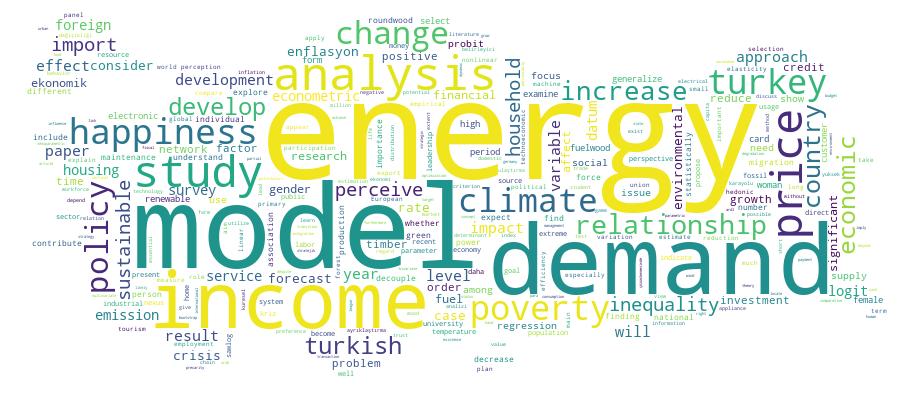
Competency Cloud
35 results
Scholarly Output Search Results
Now showing 1 - 10 of 35
Article Citation - WoS: 13Citation - Scopus: 14Energy-Saving Behavior of Turkish Women: a Consumer Survey on the Use of Home Appliances(Sage Publications Ltd, 2017) Ucal, Meltem ŞengünThis paper focuses on energy-related attitudes and behaviors of Turkish women who are the main users of electrical home appliances responsible for most household energy consumption. Answers from 1323 female respondents surveyed through a unique questionnaire formed the dataset. The results from analysis of variance show that education has a significant effect on the relationship between energy saving and awareness and attitudes about climate change. Significant differences also exist between education level groups in terms of knowledge of the classification of energy-saving electrical home appliances. Responses to questions related to energy-saving purchasing behaviors are consistently higher for knowledgeable respondents. The paper then uses factor analysis and ordinal logit models to reveal interactions between energy-saving behavior regarding electrical home appliances and several factors namely awareness sensitivity essentials and receptiveness. The identification of these factors can provide useful insights for policy makers that enable them to construct energy-saving policies specifically tailored toward women.Article Citation - WoS: 4Citation - Scopus: 4Modeling and Forecasting the Demand for Industrial Roundwood in Turkey: a Primary Econometric Approach(Wfl Publ, 2012) Kayacan, Bekir; Ucal, Meltem Şengün; Öztürk, Atakan; Bali, Ramazan; Koçer, Sacit; Kaplan, ErdemThis study is a primary econometric analysis to explore the factors explaining the changes in industrial roundwood demand in Turkey. The study also includes demand forecasts based on the econometric models proposed herein. We constructed two separate econometric models: one for national demand for domestically-produced saw log, and the other for national demand for domestically-produced non-sawlog industrial roundwood. Models were originally designed in multiplicative form. The original models are then converted into the log-linear form so that the relevant coefficients of the regression equations would immediately reflect the elasticities. Estimation of the model parameters are based on a panel data set of fifteen years (1995-2009) by twenty seven regional forest directorates in the country. In accordance with the maxim of less than the half of the 15 years period of data set, the demand forecasts are made for seven years beyond 2009. In view of the results, the explanatory power of the proposed models can arguably be deemed satisfactory especially considering the lack of earlier studies of this scale and scope. This consequently increases the credibility of the demand projections. Notwithstanding signs of the estimated parameters of the models are for the most part congruent with those expected in light of the economic theory and practice, some intriguing results are obtained. Perhaps most notably, while the sign of the estimated price elasticity of sawlog demand occurred unexpectedly positive, the variation in sawlog demand is explained to a considerable extent by the variation in the price of imported sawlog, hence an expected cross elasticity. Also notable is that the price of imported "fuelwood" holds a positive relationship with the national demand for domestic non-sawlog imdustrial roundwood, which is an expected cross elasticity since virtually all of the imported "fuelwood" is used as raw material for industry (e.g. chip and fiberboard industry). Finally, both models suggest overall boost in demand: yet an upper bound of 4.5 million m(3) for national demand for domestically-produced sawlog, and of 15 million m(3) for national demand for domestically-produced non-sawlog industrial roundwood can be expected by 2016.Article Citation - WoS: 13Citation - Scopus: 13Household Happiness and Fuel Poverty: a Cross-Sectional Analysis on Turkey(SPRINGER, 2021) Ucal, Meltem Şengün; Günay, SimgeIn recent years, self-reported happiness and fuel poverty have both become hotly-debated topics in the literature. Since both of them affect people's quality of life, they are certainly worth serious consideration. Therefore, this paper aims to conduct a household-level analysis on the association between happiness and fuel poverty taking advantage of other housing characteristics. We used ordered logit model utilizing Turkish Statistical Institute (TURKSTAT)'s 2014-2018 Life Satisfaction Survey (LSS) data for the analysis. Our dependent variable is household happiness. The results show that household fuel poverty is negatively associated with household happiness in Turkey. A positive association exists between becoming home-owner and household happiness in the country; however, it becomes mostly negative after considering odds ratios. On the other hand, there is a positive association between climbing income ladder and household happiness in the country. Also, the presence of men in households is found to be negatively associated with household happiness in Turkey. Our results imply a U-shaped association between age groups in households and household happiness in the country. Finally, we found that the association between an increase in household size and household happiness varies across each category of the independent variable. This is also the case for the association between number of rooms and household happiness as well as for the association between dwelling area and household happiness in Turkey.Article Citation - WoS: 245Citation - Scopus: 282The Role of Trade and Fdi for Co2 Emissions in Turkey: Nonlinear Relationships(Elsevier, 2019) Haug, Alfred Albert; Ucal, Meltem ŞengünThis paper examines the effects of foreign trade and foreign direct investment (FDI) on CO2 emissions in Turkey. We consider linear and nonlinear ARDL models and find significant asymmetric effects of exports, imports and FDI on CO2 emissions per capita. However, FD1 has no statistically significant long-run effects. In the long run, decreases in exports reduce CO2 emissions per capita but increases in exports have no statistically significant effects. Increases in imports push up CO2 emissions per capita, while decreases in imports have no long-run effects. On the other hand, CO2 intensity, which measures CO2 emissions per unit of energy, is not influenced by exports and imports, nor by FDI. Instead, it is affected positively by financial development and urbanization. Also, we find that an environmental Kuznets curve is present for both CO2 measures so that increases in real GDP per capita have led to reductions in CO2 emissions for at least the most recent decade, controlling for other confounding factors. Furthermore, the sectoral shares of CO2 emissions in total CO2 emissions change asymmetrically with foreign trade for two of four sectors, with export increases leading to lower CO2 shares and imports having the opposite effect. (C) 2019 Elsevier B.V. All rights reserved.Article Citation - WoS: 4Citation - Scopus: 3Perceived Happiness, Perceived Trust and Perceived Income Levels: the Case of the Reunified Germany(Savez Ekonomista Vojvodine, 2019) Ucal, Meltem Şengün; Günay, SimgeThis study explored the possible impact of perceived income on individual (perceived) happiness in Eastern and Western Germany in relation to perceived trust and four socio-economic variables, namely gender, age, marital status and employment status. To examine the relationship between these variables, a generalized ordered logit model was applied using the World Values Survey data. Bootstrapping and marginal effects were used to obtain a more robust model. The findings provided insights regarding the impact of perceived income and perceived trust on individual (perceived) happiness in both regions after reunification. Perceived income had a positive effect on all happiness categories in both regions. Perceived trust had a stronger positive impact on individual happiness than that of perceived income, although its significance varied across individual (perceived) happiness categories. Analysis of marginal effects revealed differences between the base models.Article Citation - WoS: 37Citation - Scopus: 42Turkish Public Preferences for Energy(Elsevier Science, 2018) Ediger, Volkan S.; Kirkil, Gökhan; Çelebi, Emre; Ucal, Meltem Şengün; Kentmen-Cin, ÇiğdemPublic concern over energy supplies prices sustainability and efficiency has emerged as a major issue around the world. Yet most of what we know regarding public opinion on energy comes from North America and Europe. This paper presents the results from the 2016 Turkish Public Preferences for Energy Survey which included 1204 respondents and examined Turkish residents' household energy consumption energy policy preferences and environmental concerns. The main findings were that Turkish citizens consider natural gas and electricity highly expensive view dependence on imported energy as Turkey's most pressing energy challenge and recognize the problem of climate change. This lends public support for wind and solar power but at the same time energy issues and the environment policies of political parties do not affect voting choices and political preferences.Article Citation - WoS: 21Citation - Scopus: 21A Dynamic Game Theory Model for Tourism Supply Chains(Sage Publications, 2021) Keskin, Kerim; Ucal, Meltem ŞengünThis article contributes to the game-theoretic analysis of tourism supply chains. We start with a baseline model including three types of agents: (a) one theme park, (b) multiple accommodation providers, and (c) multiple tour operators. We investigate the strategic dynamics (i.e., collaboration and competition) embedded in a market with two different tourism supply chains, and then we extend our model to an infinite-horizon repeated game arguing that agents would face the same decision problem in each week of every holiday season in each year. We show how agents in a tourism supply chain end up with higher profits in any given period of a repeated game compared with their profits in the static version of the game.Other Electronic Money in 2000's(Fırat Üniversitesi Sosyal Bilimler Dergisi, 2004) Ucal, Meltem ŞengünPara, dünya ekonomilerinin tümü için gerekli bir araçtır. Buna karşın elektronik para da gelişmiş ülkeler için gerekli bir araç haline gelmiştir. Günümüzde internet ortamı yolu ile yapılan finansal hizmetlerdeki muameleler için elektronik para ve elektronik ödeme sistemleri oldukça popülerdir. Elektronik sistemlerde meydana gelen bu değişmeler ekonomik ortamda gerçekleşen perakende satış ödemelerinde geleneksel işlemlerin yanında iki yeni formu ortaya çıkarmıştır. Bunlar, bir kişisel bilgisayar ile evden veya işyerinden banka işlemleri yapmak ve elektronik nakit kullanımıdır. Söz konusu muameleler güvene dayalı gerçekleştirilir. Özellikle de teknolojilerin hızla değiştiği 2000’li yılları kat edeken, bu sistemde gerçekleşmesi gereken en önemli unsur elektronik paranın kanunlar çerçevesinde değerlendirilmesidir. Fakat Türkiye elektronik para sistemleri için henüz bir kanuni çerçeve çizmemiştir.Article Citation - WoS: 6Citation - Scopus: 6Is Precarity a Fate for Women in Türkiye? Rethinking Energy Poverty From a Gender Perspective(Springer Heidelberg, 2023) Ucal, Meltem; Gunay, SimgeEnergy poverty is a challenging issue that hampers economic and sustainable development and lowers people's standard of living. While trying to understand energy poverty, it is imperative to focus on the disadvantaged individuals mentioned in the literature, as they are often most vulnerable to the problem. Focusing on them is essential to achieving sustainable development goals, especially in developing countries, particularly regarding poverty, energy poverty, and gender equality. Therefore, the paper aims to examine the impact of economic precarity on working-age females' energy poverty perceptions using 2018-2020 TURKSTAT-SILC pooled cross-sectional data. Our findings from the bivariate probit, multivariate probit and Bayesian bivariate probit models suggested that economic precarity has a disruptive role on females' energy poverty perceptions. Furthermore, inefficient energy use is an important factor in influencing females' perceptions of energy poverty. Females' inability to pay required housing expenses increases their perceived energy poverty. Therefore, social-welfare policies and energy policies should be considered together by the policymakers to resolve females' energy poverty problem to achieve a more sustainable future.Article Citation - WoS: 5Citation - Scopus: 4Is Fiscal Policy Sustainable in Turkey?(M.E Sharpe Inc., 2010) Ucal, Meltem Şengün; Alici, AsliThe issue of the budget deficit has become one of the main themes of the economic policy implemented in Turkey and backed by the International Monetary Fund (IMF) following the economic crisis of 2001. The main motivation for this study is the question of whether or not the government's financial policy is sustainable and satisfies the government's long-term budget constraint. The empirical analysis is based on tests of whether government expenditure and revenue are cointegrated considering the economic liberalization period of 1989-2008. The stability of fiscal policy is examined using the Johansen multivariate cointegration method. The findings of the sustainability tests indicate that fiscal policy from the liberalization of the economy up until the 2001 economic crisis was not sustainable.
