Güleşen, Sevilay

Loading...
Profile Picture
Name Variants
Güleşen, Sevilay
S.,Güleşen
S. Güleşen
Sevilay, Güleşen
Gulesen, Sevilay
S.,Gulesen
S. Gulesen
Sevilay, Gulesen
Güleşen, S.
Job Title
Misafir Öğr. Gör.
Email Address
Main Affiliation
Core Program
Status
Former Staff
Website
ORCID ID
Scopus Author ID
Turkish CoHE Profile ID
Google Scholar ID
WoS Researcher ID

Sustainable Development Goals

15

LIFE ON LAND
LIFE ON LAND Logo

0

Research Products

16

PEACE, JUSTICE AND STRONG INSTITUTIONS
PEACE, JUSTICE AND STRONG INSTITUTIONS Logo

0

Research Products

14

LIFE BELOW WATER
LIFE BELOW WATER Logo

0

Research Products

6

CLEAN WATER AND SANITATION
CLEAN WATER AND SANITATION Logo

0

Research Products

3

GOOD HEALTH AND WELL-BEING
GOOD HEALTH AND WELL-BEING Logo

1

Research Products

17

PARTNERSHIPS FOR THE GOALS
PARTNERSHIPS FOR THE GOALS Logo

0

Research Products

4

QUALITY EDUCATION
QUALITY EDUCATION Logo

1

Research Products

2

ZERO HUNGER
ZERO HUNGER Logo

0

Research Products

10

REDUCED INEQUALITIES
REDUCED INEQUALITIES Logo

0

Research Products

7

AFFORDABLE AND CLEAN ENERGY
AFFORDABLE AND CLEAN ENERGY Logo

0

Research Products

13

CLIMATE ACTION
CLIMATE ACTION Logo

0

Research Products

1

NO POVERTY
NO POVERTY Logo

0

Research Products

9

INDUSTRY, INNOVATION AND INFRASTRUCTURE
INDUSTRY, INNOVATION AND INFRASTRUCTURE Logo

0

Research Products

12

RESPONSIBLE CONSUMPTION AND PRODUCTION
RESPONSIBLE CONSUMPTION AND PRODUCTION Logo

0

Research Products

8

DECENT WORK AND ECONOMIC GROWTH
DECENT WORK AND ECONOMIC GROWTH Logo

0

Research Products

11

SUSTAINABLE CITIES AND COMMUNITIES
SUSTAINABLE CITIES AND COMMUNITIES Logo

0

Research Products

5

GENDER EQUALITY
GENDER EQUALITY Logo

0

Research Products
This researcher does not have a Scopus ID.
This researcher does not have a WoS ID.
Scholarly Output

2

Articles

0

Views / Downloads

13/226

Supervised MSc Theses

1

Supervised PhD Theses

0

WoS Citation Count

0

Scopus Citation Count

1

WoS h-index

0

Scopus h-index

1

Patents

0

Projects

0

WoS Citations per Publication

0.00

Scopus Citations per Publication

0.50

Open Access Source

2

Supervised Theses

1

Google Analytics Visitor Traffic

JournalCount
F1000Research1
Current Page: 1 / 1

Scopus Quartile Distribution

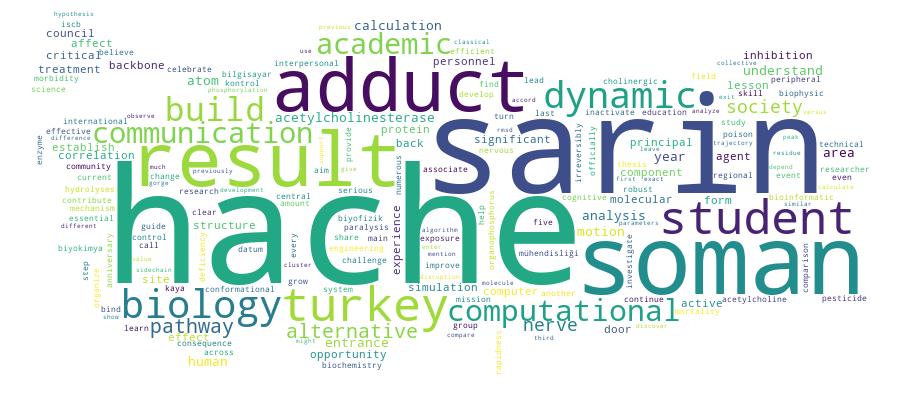
Competency Cloud

GCRIS Competency Cloud

Scholarly Output Search Results

Now showing 1 - 2 of 2
  • Editorial
    Citation - Scopus: 1
    Lessons From a Ten-Year Journey: Building a Student-Driven Computational Biology Society Across Turkey
    (NLM (Medline), 2022) Kaya, Y.; Karakulak, T.; Can, Saylan, C.; Gür, E.R.; Tatlıdil, E.; Güleşen, S.; Betül Dinçaslan, F.
    The Regional Student Group Turkey (RSG-Turkey) is officially associated with the International Society for Computational Biology (ISCB) Student Council (SC). At the RSG-Turkey, we aim to contribute to the early-career researchers in computational biology and bioinformatics fields by providing opportunities for improving their academic and technical skills in the field. Over the last ten years, we have built a well-known student-driven academic society in Turkey that organizes numerous events every year and continues to grow with over 650 current members. Celebrating the 10th anniversary of RSG-Turkey, in this communication, we share our experiences, five main lessons we learned, and the steps to establish a long-standing academic community: having a clear mission, building a robust structure, effective communication, turning challenges into opportunities, and building collaborations. We believe that our experiences can help students and academics establish long-standing communities in fast-developing areas like bioinformatics. Copyright: © 2022 Kaya Y et al.
  • Master Thesis
    Effects of Nerve Agents on Conformational Dynamics of Acetylcholinesterase
    (Kadir Has Üniversitesi, 2021) Güleşen, Sevilay; Gökhan, Şebnem Eşsiz
    Human acetylcholinesterase (hAChE), an essential enzyme in the central and peripheral nervous system, hydrolyses acetylcholine (ACh) at the cholinergic synapses. Organophosphorus pesticides (OPs), also called nerve agents, can inactivate the hAChE irreversibly and leads to serious morbidity (such as paralysis, cognitive deficiencies, and seizures) and even mortality consequences based on the amount of exposure and rapidness of treatment. Therefore, understanding the inhibition mechanism of hAChE by OPs, such as soman and sarin, is critical since it may guide developing a new and efficient treatment for poisoning by the nerve agents. The effects of soman inhibition on the dynamics of the hAChE were investigated in comparison with the results of the molecular dynamics study of the apo form and another OP adducted, i.e. soman adducted, form of hAChE in 2005. To understand the changes in the protein structure of hAChE after binding soman, 40 MD data were published. In this thesis, we aimed to find how sarin phosphorylation of the active site Ser203 residue of the hAChE affects the protein dynamics and to compare the result with the previously discovered results of the apo and soman-adducted hAChE. First, 40 classical MD simulations for the sarin adducted hAChE were run with the exact parameters of the apo and soman-adducted hAChE simulations. The sarin adducted hAChE was used for the MD simulations. Resulting trajectories were analyzed with RMSD analysis, principal component analysis (PCA), and K-means clustering algorithm calculations to understand the differences between collective motions of the apo, soman adducted, and sarin adducted hAChE. According to the results, the sarin molecule has an alternative pathway for entering and leaving from the active site of the hAChE like the soman molecule. The back door area when it is calculated from the backbone atoms versus the sidechain atoms shows a significant different behavior. The backbone atoms calculation of the sarin-adducted gives similar results with the apo simulation. However, there is a significant third peak at much larger value observed in the calculation of the sarin-adducted sidechain. That might be an alternative pathway for entrance to the molecule. Also, the gorge entrance and back door motion correlation is affected when hAChE is adducted by sarin, depending on correlation analysis. This disruption and the previous mentioned above area results support the hypothesis about alternative pathways for entrance and exit in the protein. All these motions and alternative pathways are critical for the development of the treatment of sarin poisoning. Keywords: Molecular dynamic simulation, acetylcholinesterase, sarin, soman, principal component analysis