Hisarlıoğlu, Fatma Fulya

Loading...
Profile Picture
Name Variants
H., Fatma Fulya
Hisarlıoğlu, F. F.
Hisarlıoğlu, FATMA FULYA
H.,Fatma Fulya
Hisarlıoğlu, Fatma Fulya
F. F. Hisarlıoğlu
Hisarlioglu,F.F.
FATMA FULYA HISARLIOĞLU
Hisarlioglu, Fatma Fulya
Hisarlıoğlu,F.F.
Hisarlıoğlu, F.
Fatma Fulya Hisarlıoğlu
Fatma Fulya, Hisarlioglu
F. Hisarlıoğlu
Hisarlioğlu F.
HISARLIOĞLU, Fatma Fulya
Fatma Fulya HISARLIOĞLU
HISARLIOĞLU, FATMA FULYA
Hisarlioglu,Fatma Fulya
Hisarlioglu, Fulya
Job Title
Dr. Öğr. Üyesi
Email Address
Main Affiliation
Political Science and International Relations
Status
Current Staff
Website
ORCID ID
Scopus Author ID
Turkish CoHE Profile ID
Google Scholar ID
WoS Researcher ID

Sustainable Development Goals

4

QUALITY EDUCATION
QUALITY EDUCATION Logo

0

Research Products

6

CLEAN WATER AND SANITATION
CLEAN WATER AND SANITATION Logo

0

Research Products

10

REDUCED INEQUALITIES
REDUCED INEQUALITIES Logo

0

Research Products

13

CLIMATE ACTION
CLIMATE ACTION Logo

0

Research Products

14

LIFE BELOW WATER
LIFE BELOW WATER Logo

0

Research Products

2

ZERO HUNGER
ZERO HUNGER Logo

0

Research Products

8

DECENT WORK AND ECONOMIC GROWTH
DECENT WORK AND ECONOMIC GROWTH Logo

0

Research Products

12

RESPONSIBLE CONSUMPTION AND PRODUCTION
RESPONSIBLE CONSUMPTION AND PRODUCTION Logo

0

Research Products

9

INDUSTRY, INNOVATION AND INFRASTRUCTURE
INDUSTRY, INNOVATION AND INFRASTRUCTURE Logo

0

Research Products

17

PARTNERSHIPS FOR THE GOALS
PARTNERSHIPS FOR THE GOALS Logo

1

Research Products

1

NO POVERTY
NO POVERTY Logo

0

Research Products

11

SUSTAINABLE CITIES AND COMMUNITIES
SUSTAINABLE CITIES AND COMMUNITIES Logo

1

Research Products

15

LIFE ON LAND
LIFE ON LAND Logo

0

Research Products

3

GOOD HEALTH AND WELL-BEING
GOOD HEALTH AND WELL-BEING Logo

0

Research Products

7

AFFORDABLE AND CLEAN ENERGY
AFFORDABLE AND CLEAN ENERGY Logo

0

Research Products

5

GENDER EQUALITY
GENDER EQUALITY Logo

0

Research Products

16

PEACE, JUSTICE AND STRONG INSTITUTIONS
PEACE, JUSTICE AND STRONG INSTITUTIONS Logo

1

Research Products
Documents

9

Citations

31

h-index

3

This researcher does not have a WoS ID.
Scholarly Output

10

Articles

5

Views / Downloads

6/0

Supervised MSc Theses

0

Supervised PhD Theses

0

WoS Citation Count

21

Scopus Citation Count

46

WoS h-index

2

Scopus h-index

3

Patents

0

Projects

0

WoS Citations per Publication

2.10

Scopus Citations per Publication

4.60

Open Access Source

3

Supervised Theses

0

JournalCount
Palgrave Studies in International Relations3
Cooperation and Conflict1
International Studies Review1
Journal of Balkan and Near Eastern Studies1
Review of International Studies1
Current Page: 1 / 2

Scopus Quartile Distribution

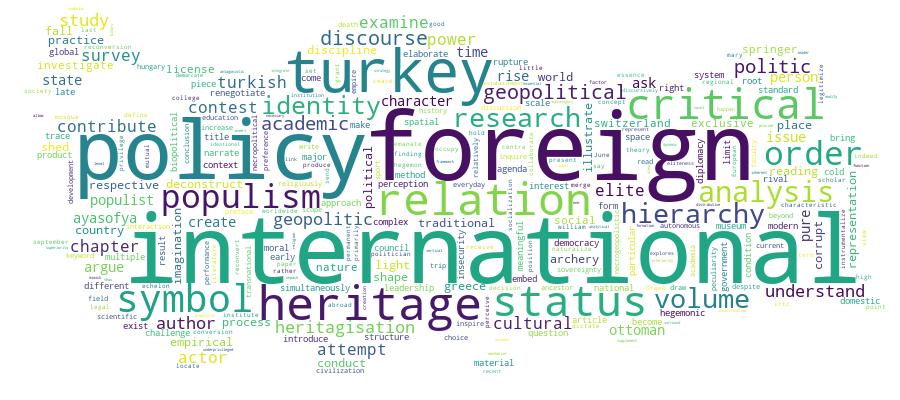
Competency Cloud

GCRIS Competency Cloud

Scholarly Output Search Results

Now showing 1 - 10 of 10
  • Book Part
    Introduction: Why Critical Approaches in Foreign Policy Analysis
    (Palgrave Macmillan, 2022) Erdoğan, B.; Hisarlıoğlu, F.
    This volume titled Critical Readings of Turkey’s Foreign Policy has both theoretical and empirical ambitions. First, by bringing together different authors and their research, the volume asks overall whether we can study foreign policy-making in a meaningful academic way by using critical constructivist, discursive, post-colonial, post-structuralist, and gender approaches. Secondly, each chapter analyses certain actors and events by developing an empirically informed research agenda. With these efforts, the volume investigates what foreign policy means and addresses particular cases while asking how we can broaden such a critical research agenda to study foreign policy in general. The authors agree that we can study actors by looking into their internal and external worlds, which condition them and are also conditioned by them. The authors in this volume assume that actors are products of their complex environments. Chapters accordingly shed light on the social-cultural—political-economic context, power relations, boundaries of inclusion and exclusion, by inspecting identity constructions and political articulations. In chapters, discourses on new and old geographies, borders, emerging security and insecurities (usually insecurities), and the confirming or contesting of orders embedded in power relations and exterior structures are investigated in acritical manner. Methodologically, this volume asks important empirical questions, such as what tools are available for researchers to understand the complex social realities and identities of actors and how we can utilise them in meaningful ways. In this process, the authors investigate several creative ways to make more sense of their research topics and subjects. Particularly in studying a subject that has not always been stable and that has multiple identities and belongings, the authors employ diverse methods while maintaining a spirit of continuous curiosity and academic exploration. © The Author(s), under exclusive license to Springer Nature Switzerland AG 2022.
  • Article
    Citation - Scopus: 10
    An Analysis of International Relations Academics in Turkey and Their Approaches To the Field: Trip 2014 Faculty Survey Results;
    (International Relations Council of Turkey, 2016) Aydin,M.; Hisarlioğlu,F.; Yazgan,K.
    Despite the increasing interest in the studies inquiring the limits, autonomous character of and the interactions between the International Relations (IR) discipline and other academic fields, the scope and scale of empirical research on these issues are relatively small. In order to contribute to the discussion on the limits and peculiarities of the IR discipline and to shed light on the development, current status and major characteristics of the IR studies in Turkey, its place in the global IR discipline and the views of IR scholars on major issues on the global, regional and national agenda, two surveys were conducted by the International Relations Council of Turkey (IRCT) in 2007 and 2009. Later on, the IRTC collaborated with the Institute for the Theory and Practice of International Relations at the College of William and Mary to conduct further surveys in 2011 and 2014. This paper presents findings of the last survey on Turkey, based on the worldwide research simultaneously conducted in 31 different countries in September 2014. © 2016, International Relations Council of Turkey. All rights reserved.
  • Article
    Heritage Geopolitics: Hegemonic Meaning-Making, International Orders, and the Heritagisation of Traditional Archery in Turkey and Beyond
    (Cambridge Univ Press, 2025) Hisarlioglu, Fulya; Yanik, Lerna K.
    This piece argues that to understand how cultural heritage functions as a form of power at the international level, it is essential to deconstruct the 'productive politics' that surround and shape the material and symbolic spatial formations of heritage and heritagisation. To this aim, by integrating critical accounts on heritage politics, geopolitics, and biopolitics, this piece deconstructs the dynamics of Turkey's heritagisation of traditional Turkish archery (TTA) in Turkey and beyond. We introduce heritage geopolitics as a novel analytical framework to unpack the role of these multiple intertwined scales of spaces in heritagisation and the 'productive politics' behind it. Heritage geopolitics, explained through the heritagisation of TTA, helps to illustrate how heritagisation becomes a multiscalar hegemonic process that shapes various features of the domestic and international orders, from the biopolitical to the geopolitical, attempting to challenge existing narratives of power and moral authority. We demonstrate that heritage geopolitics differs from other uses of heritage in world politics (such as cultural diplomacy, heritage diplomacy, or soft power) by foregrounding the domestic and embodied moral foundations of biopolitical and geopolitical imaginations embedded in the heritagisation processes.
  • Article
    Citation - WoS: 2
    Citation - Scopus: 1
    Identity, Cultural Heritage and the Politics of Sovereignty: Narrating Turkey and Greece Through Ayasofya
    (Routledge Journals, Taylor & Francis Ltd, 2024) Hisarlioglu, Fulya; Karagiannopoulou, Chara; Yanik, Lerna K.
    The article examines how Turkey's decision to reconvert the Ayasofya Museum into a mosque in June 2020 has shaped the 'self' and 'other' perceptions of the Greek and Turkish politicians of their respective countries by instrumentalizing the concept of sovereignty. We argue that what has been termed 'the right to sovereignty' by Turkey's leadership through the reconversion of Ayasofya-from a museum to a mosque-is indeed a 'sovereignty performance'. What is more, we deconstruct how 'sovereignty performances' centred on the conversion of Ayasofya produced by Turkey and Greece came to define, narrate and naturalize the essence and standards of 'national' and 'foreign/international' legitimizing mutual and respective identity perceptions held for themselves and each other.
  • Article
    Citation - WoS: 3
    The Rise and Fall of the Ottoman Empire's Religiously Inspired Status Symbols
    (Sage Publications Ltd, 2024) Hisarlioglu, Fulya; Yanik, Lerna K.
    How do status symbols rise and fall? Or better said, how does a status symbol become a status symbol and then cease to be one? We examine the rise and the fall of the Ottoman Empire's two socialization practices with the international society as status symbols: sending and receiving envoys/establishing permanent representation abroad and granting capitulations/extraterritoriality-economic and legal privileges to primarily European countries. We argue and illustrate that status symbols are products of hegemons of the time that dictate the status symbols of the international order at that particular point in time, with little or no recognition. These symbols emanating from the position that the states occupy in the hierarchy can be status-enhancing rather than status-achieving if these states perceive and locate themselves in the higher echelons of the hierarchy in the international order. We contribute to status-seeking literature by examining the rise and fall of status symbols in a non-Western setting and merging ideational and material factors in status-seeking literature.
  • Book Part
    Citation - Scopus: 15
    'they Wrote History With Their Bodies': Necrogeopolitics, Necropolitical Spaces and the Everyday Spatial Politics of Death in Turkey
    (Edinburgh University Press, 2019) Yanik, L.K.; Hisarlioğlu, F.
    [No abstract available]
  • Article
    Citation - WoS: 16
    Citation - Scopus: 18
    Contesting the Corrupt Elites, Creating the Pure People, and Renegotiating the Hierarchies of the International Order? Populism and Foreign Policy-Making in Turkey and Hungary
    (Oxford Univ Press, 2022) Hisarlioglu, Fulya; Yanik, Lerna K.; Korkut, Umut; Civelekoglu, Ilke; Hisarlloǧlu, Fulya; Yanlk, Lerna K.
    This article explores the link between populism and hierarchies in international relations by examining the recent foreign policy-making in Turkey and Hungary-two countries run by populist leaders. We argue that when populists bring populism into foreign policy, they do so by contesting the corrupt elites of the international order and, simultaneously, attempt to create the pure people transnationally. The populists contest the eliteness and leadership status of these elites and the international order and its institutions, that is, the establishment, that these elites have come to represent by challenging them both in discourse and in action. The creation of the pure people happens by discursively demarcating the underprivileged of the international order as a subcategory based on religion and supplementing them with aid, thus mimicking the distributive strategies of populism, this time at the international level. We illustrate that when populist leaders, insert populism into foreign policies of their respective states, through contesting the corrupt elites and creating the pure people, the built-in vertical stratification mechanisms of populism that stems from the antagonistic binaries inherent to populism provide them with the necessary superiority and inferiority labels allowing them to renegotiate hierarchies in the international system in an attempt to modify the existing ones or to create new ones.
  • Book Part
    Conclusions Drawn from Critical Readings of Turkey’s Foreign Policy
    (Palgrave Macmillan, 2022) Erdoğan, B.; Hisarlıoğlu, F.
    Acknowledging the necessity of making critical analyses and research in foreign policy, the authors who contributed to this volume titled Critical Readings of Turkey’s Foreign Policy have all attempted to leave their trace by asking timely questions to understand the ruptures, insecurities, temporalities, and identity crises in Turkey’s foreign policy. In this way, this book not only examines a number of selected and significant issues in Turkey’s contemporary foreign policy but also elaborates on the ideas, discourses, actors, processes, and structures in foreign policy-making and the temporal and inconsistent character of the foreign policy ecosystem. Showing the multi-layered, split, and complicated character of the social entity called “state”, this volume understands foreign policy not as an interest and result oriented pre-determined endeavour but as a social terrain where discourses, power hierarchies, transforming identities, norms, representations, and negotiations take place. In this way, this volume does not only contribute to the critical analyses of Turkey’s foreign policy and but also to the Foreign Policy Analysis as an academic field. © The Author(s), under exclusive license to Springer Nature Switzerland AG 2022.
  • Editorial
    Preface
    (Association for Computing Machinery, Inc, 2022) Sra, Misha; Ortega, Francisco Raul; Piumsomboon, Thammathip; Weyers, Benjamin; Peck, Tabitha C.; Barrera, Mayra; Punpongsanon, Parinya; Hogan, Aidan; Kim, Aise; Borst, Christoph; Weissker, Tim; Roman, Dumitru; Aktaş, Gürhan; Dağ, Hasan; Skarbez, Rick; Çelikpala, Mitat; Mair, Judith; Batmaz, Anil; Hisarlıoğlu, Fulya; Kozak, Metin; Kim, Kangsoo; Bruder, Gerd; Soylu, Ahmet; Turhan, Anni-Yasmin; Zielasko, Daniel; Teather, Robert; Satoh, Ken; Barrera Machuca, Mayra; Erdoğan, Birsen
  • Book Part
    Citation - Scopus: 2
    A Critical Geopolitical Reading of Turkish Foreign Policy
    (Palgrave Macmillan, 2022) Hisarlıoğlu, F.
    This scholarly attempt seeks to understand the evolution of discourses, practices, and representations of the “geopolitical facts” about Turkey’s place in the (West-centric) world order over time. It traces the issue back to the late Ottoman era, elaborating on the transformation of geopolitical codes from a civilisational/imperial discourse to a national one. At the same time, it analyses the rival and alternative geopolitical visions in the era of the modern Turkish Republic as manifestations of deeply rooted contestations about Turkey’s (geo)political identity. With its historical outlook, this chapter will contribute to the analysis and understanding of the intellectual context and political atmosphere that has fermented the discourses on Turkey’s true place in the modern system of states in the period between early Republican era and the end of Cold War bipolarity. By shedding light on the historically rooted rival geopolitical imaginations of Turkey’s geographical character, this chapter introduces the initial forms, early experimentations of, ruptures, and continuities in geopolitical imaginations of Turkey up until the end of Cold War. © The Author(s), under exclusive license to Springer Nature Switzerland AG 2022.