
Şaher, Konca
Loading...

Profile URL
Name Variants
Şaher,K.
K. Şaher
KONCA ŞAHER
S., Konca
ŞAHER, Konca
Şaher, KONCA
S.,Konca
Şaher, Konca
Konca Saher
Saher,Konca
Saher,K.
ŞAHER, KONCA
Ş., Konca
Saher K.
Şaher K.
Şaher, K.
K. Saher
Konca Şaher
Saher, K.
Saher, Konca
Konca, Saher
Konca ŞAHER
K. Şaher
KONCA ŞAHER
S., Konca
ŞAHER, Konca
Şaher, KONCA
S.,Konca
Şaher, Konca
Konca Saher
Saher,Konca
Saher,K.
ŞAHER, KONCA
Ş., Konca
Saher K.
Şaher K.
Şaher, K.
K. Saher
Konca Şaher
Saher, K.
Saher, Konca
Konca, Saher
Konca ŞAHER
Job Title
Doç. Dr.
Email Address
Main Affiliation
Interior Architecture and Environmental Design
Status
Current Staff
Website
ORCID ID
Scopus Author ID
Turkish CoHE Profile ID
Google Scholar ID
WoS Researcher ID
Sustainable Development Goals
4
QUALITY EDUCATION

2
Research Products
8
DECENT WORK AND ECONOMIC GROWTH

1
Research Products
11
SUSTAINABLE CITIES AND COMMUNITIES

3
Research Products
14
LIFE BELOW WATER

1
Research Products
16
PEACE, JUSTICE AND STRONG INSTITUTIONS

2
Research Products
17
PARTNERSHIPS FOR THE GOALS

2
Research Products

Documents
28
Citations
99
h-index
3

Documents
10
Citations
47

Scholarly Output
23
Articles
6
Views / Downloads
203/798
Supervised MSc Theses
1
Supervised PhD Theses
0
WoS Citation Count
22
Scopus Citation Count
61
WoS h-index
2
Scopus h-index
2
Patents
0
Projects
0
WoS Citations per Publication
0.96
Scopus Citations per Publication
2.65
Open Access Source
3
Supervised Theses
1
Google Analytics Visitor Traffic
| Journal | Count |
|---|---|
| Proceedings of Forum Acusticum -- 10th Convention of the European Acoustics Association, EAA 2023 -- 11 September 2023 through 15 September 2023 -- Torino -- 198863 | 3 |
| -- 31th International Congress on Sound and Vibration, ICSV 2025 -- 2025-07-06 through 2025-07-11 -- Incheon -- 214143 | 2 |
| 30th International Congress on Sound and Vibration -- Jul 08-11, 2024 -- Amsterdam, Netherlands | 2 |
| A Companion to Modern Turkey's Centennial: Political, Sociological, Economic and Institutional Transformations since 1923 | 2 |
| Applied Acoustics | 2 |
Current Page: 1 / 3
Scopus Quartile Distribution
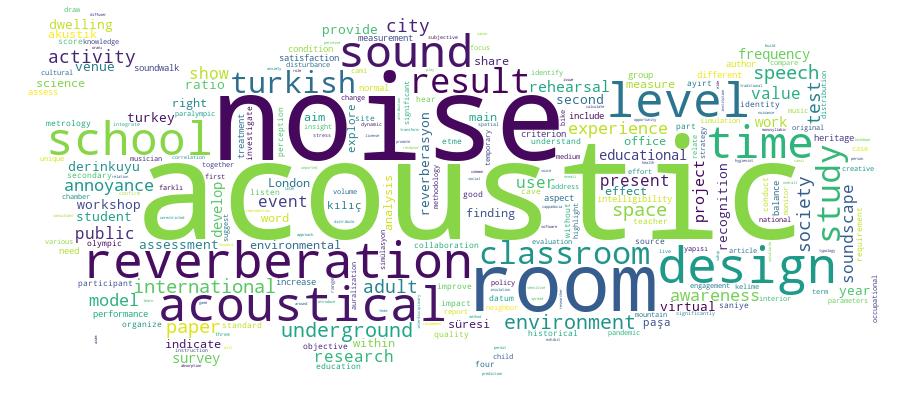
Competency Cloud
Scholarly Output Search Results
Now showing 1 - 10 of 23
Book Part Citation - Scopus: 1Turkey's Seven Decades of Ebb and Flow Within Nato(Edinburgh University Press, 2023) Açikmeşe, S.A.; Ovali, A.S.[No abstract available]Master Thesis Kılıç Ali Paşa Camii Akustik Mirası Değerlendirmesi : Modern Bir Camii ile Akustik Performans Karşılaştırması(Kadir Has Üniversitesi, 2018) Kocaer, Rabia; Şaher, KoncaTarihi cami yapılarının korunmasında görsel algı dışında işitselliğin mekandaki algısının farkındalığını sağlamak düşünülmüştür. Bu çalışmada Mimar Sinan'nın önemli yapısı olan Kılıç Ali Paşa Camisi'nin restorasyon sürecindeki akustik değerlendirmesive günümüz modern cami yapısı ile akustik performans karşılaştırması yapılmıştır. Arşiv taramaları, mimari projeler, yerinde görme, bilgi ve belge araştırmaları yapılmıştır. Kılıç Ali Paşa Camii ve İmam-ı Azam Camisi'ne ait autocad ve sketchup programlarından yararlanılarak 3D modellemeleri yapılmıştır. Söz konusu camilerin hacim akustiği kriterlerinden olan Reverberasyon Süresi (RT) ve Konuşmanın İletim İndeksi (STI) değerleri elde edilmiştir. Çalışma sonucunda Kılıç Ali Paşa Camisi'nin orijinal hali ve restorasyon süreci ile caminin mevcut durumunun simülasyon verileri karşılaştırılmış ve Kılıç Ali Paşa Cami mevcut durumu ile İmam-ı Azam Cami'nin simülasyon verilerinin karşılaştırılarak değerlendirilmesi yapılmıştır.16.yüzyıl yapısı olan Kılıç Ali Paşa Camisi'nin 21.yüzyıl yapısı olan İmam-ı Azam Camisi'ne göre daha iyi akustik değerlere sahip olduğu elde edilen veriler sonucunda ortaya çıkmıştır.Book Part Article Acoustic Assessment of Four Music Rehearsal Rooms in Accordance With ISO23591 Standard(Elsevier Sci Ltd, 2025) Saher, Konca; Ozgencil, Yalin; Khoshkholghi, SolmazOptimizing rehearsal room acoustics is crucial for musicians to perceive sound, pitch, and frequency variations. Since the introduction of the international standard ISO 23591 Acoustic quality criteria for music rehearsal rooms and spaces, research in the field of music rehearsal rooms has significantly intensified. However, relatively few have adopted an approach that integrates both objective measurements and subjective user evaluations, particularly in rehearsal rooms for quiet-category instruments. Therefore, this study aimed to assess and improve the acoustical conditions of four Turkish rehearsal rooms for quiet-category instruments using measurements, simulations, and musician surveys. A survey conducted in the first phase revealed that musicians rated the efficiency, satisfaction, and frequency balance of four rehearsal rooms as bad to fair. Efficiency of rehearsals showed a strong correlation with frequency balance (R2 = 0.72 for low-to-mid; R2 = 0.76 for high-to-mid). Strong correlations (R2 = 0.93) were found between calculated and perceived low-to-mid frequency balance, while high-to-mid frequency balance showed weaker correlations (R2 = 0.36), suggesting possible sensitivity to low-frequency issues; though this did not consistently align with user satisfaction, indicating that additional perceptual factors play a role. Acoustic measurements show that existing reverberation time (RTmid) values for all rooms fall outside recommended limits. The measured rehearsal rooms were modeled, calibrated, and 36 acoustic models were developed with three alternative designs to improve acoustics within recommended limits. Then musicians from these rooms assessed 36 acoustic models through listening tests based on auralizations. Listening tests showed a preference for models with RTmid values within the recommended range, aligning subjective and objective assessments. After the RTmid value, effect of low-to-mid frequency balance was important in the choice of rooms for musicians.Conference Object Citation - Scopus: 2Towards New Acoustic Policies in the 'new Normal' of the Covid-19 Pandemic(International Commission for Acoustics (ICA), 2022) Şentop Dümen, A.; Şaher, K.; Kurra, S.In 2020, Turkish Acoustical Society conducted a survey to measure the pandemic's impact on acoustic evaluation of residential buildings. 1053 people participated in this survey and answered to the questions on their noise annoyances before and during the Covid-19. Results indicated an increased acoustical comfort during the lock-downs due to the decreased environmental noise, but also highlighted the importance of interior noises (from neighbouring dwellings and from one's own dwelling). Other studies from all over the world reported similar results for the first wave of the pandemics. After two years of experience, the question of how user behaviour, acoustical perception and expectance have changed is yet to be answered in order to develop correct strategies and strengthen the acoustical policies for accomplishing sustainable cities. This paper introduces the results of the 2020 study and gives an analysis of the current literature on (1) acoustic perception during the pandemics, (2) working from home and its persistency, and (3) changed user habits in dwellings and in cities. The acoustical requirements in the era of 'new normal' and policy implications are discussed. © ICA 2022.All rights reservedConference Object Reflections on the International Noise Awareness Day 2023 Activities(Int Inst Acoustics & Vibration, 2024) Saher, Konca; Dumen, Ayca Sentop; Sezgin, Hakika; Nas, Sezin; Kelle, Dilara; Demiral, YacelThis paper presents an overview of the experiences and outcomes derived from the activities organized for International Noise Awareness Day 2023 in Turkey with the theme "Keep your hearing, keep your health". Collaboratively organized by Turkish Acoustical Society, and Occupational Hygienists Society, the initiatives aimed to explore the role of sound in educational facilities, with a particular focus on the perspectives of students and teachers. These activities were a student drawing competition, an online International Symposium, a research project titled "Assessment of Acoustic Conditions in Schools and Health Effects on School," and an "Acoustics Workshop in Educational Buildings" conducted at the Izmir BLX Acoustics Laboratory. Drawing from our experiences and findings, we highlight the significance of actively involving researchers, acoustic consultants, occupational hygienists, teachers, students, and designers in such endeavours. Our findings indicate that inclusive approaches not only boost public engagement but also enhance awareness of behavioural, emotional, educational, administrative and design aspects related to sound. By promoting collaboration and participation in knowledge exchange, such activities significantly improve understanding of sound-related issues in schools.Article Citation - WoS: 2The Effect of Reverberation Time and Signal-To Ratio on Word Recognition Scores by Adults and Children in Classrooms(Yıldız Technical Univ, 2019) Şaher, Konca; Karaböce, BakiThis paper seeks to assess the effect of reverberation time, distribution of reverberation time over the frequency range and signal-to-noise ratio on speech intellibility by adults and children in classrooms by the use of phonetically balanced monosyllabic Turkish word recognition tests. Two sets of 25-items phonetically balanced monosyllabic Turkish words were recorded in a full anechoic chamber. Auralizations of the recordings were developed in an acoustic simulation software for a range of reverberation time of 0,8 seconds (average of 500 Hz, 1000 Hz ve 2000 Hz), 0,4 seconds (average of 500 Hz, 1000 Hz ve 2000 Hz) and 0,4 seconds (125-4000 Hz) and two signal-to-noise ratios of 0 dB and 15dB in a typical classroom. Listening tests developed from auralizations were presented to adults and children. The results show that when reverberation time (average of 500 Hz, 1000 Hz ve 2000 Hz) is reduced from 0.8 seconds to 0.4 seconds for both signal-to-noise ratios of 0 dB and 15 dB, the percentage of speech recognition scores increases in both adults and children. However, in case of 0 dB signal-to-noise, when the reverberation time falls from 0.4 seconds (average of 500 Hz, 1000 Hz ye 2000 Hz) to 0.4 seconds (125-4000 Hz) while there is no significant improvement in the word recognition scores by adults, there is a significant improvement in childrens' scores. For the 15 dB signal-to-noise ratio case, reverberation time of 0,4 seconds (125 - 4000 Hz) does not have a notable impact on word recognition scores for both children and adults.Conference Object Insights From the ‘Acoustics Workshop in Educational Buildings’ by Turkish Acoustical Society(Societe Francaise d'Acoustique, 2024) Şaher, K.; Sentop-Dumen, A.; Sezgin, H.; Nas, S.; Kelle, D.This paper focuses on "Acoustics Workshop in Educational Buildings" organized by the Turkish Acoustical Society as part of International Noise Awareness Day 2023 Activities. The workshop brought together 34 participants, including designers, acoustic experts, teachers, and health and occupational safety professionals. Through interdisciplinary discussions, participants identified and prioritized acoustic problems, expectations and requirements for educational buildings, focusing on improving the quality of education. The workshop unfolded in two stages: firstly, participants were grouped by profession to identify primary acoustic challenges. Subsequently, multi-disciplinary teams collaboratively developed mitigation strategies to address these challenges. The results revealed profession-specific insights into main acoustic issues and proposed actionable solutions. This paper specifically provides insights into the use of qualitative content analysis to have a deeper understanding of different professions, people's experiences, behavior and priorities in relation to acoustics in school. © 2025 Elsevier B.V., All rights reserved.Article Mountain Bike Venue Test Event Noise Assessment London 2012 Olympic and Paralympic Games(Studıo D-Akustika Sro, 2016) Şaher, KoncaThis article reports the results of the noise monitoring during the London 2012 Mountain Biking Test Event which was held at Hadleigh Farm. The noise monitoring was held during the Mountain Bike Test Event for two purposes: Firstly as part of the requirements of Environmental Management Plan for the Test Event to ensure that no noise disturbance was being caused and the noise levels were below the agreed criterion of 65 dB(A) at the noise sensitive receptors during the Test Event and secondly to check whether any additional mitigation measures need to be adopted for the main Olympic Event. The noise monitoring results indicate that the L-Aeq noise levels at the selected two noise sensitive receptors were below the 65 dB(A) criterion. The results confirmed the predictions that the crowd noise was not a noise nuisance during the Test Event and the results further showed that no noise nuisance at the noise sensitive receptors was caused by public adress system. The public address system to be used during the main event was very similar to the Test Event therefore it was possible to conclude that the noise nuisance from the event (public address system and spectator noise) could be assessed as being moderate to low risk during the main Games.Conference Object Blending Science and Art: an Educational Perspective(Iated-Int Assoc Technology Education & Development, 2019) Balkır Kuru, Nur; Şaher, Konca; Mıhçı, Gürkanrt and design education enable students to find creative and logical solutions to various design problems. The use of materials, constructive analysis, craftmanship, and originality are some key criteria in the process. Size and dimensionality, the proportion analysis, expression integrity, substantiality, and presentability can vary depending on the project and the context. As one of the methods used to provide targeted experience and learning in art and design education, interdisciplinary work presents a right ground for complex design issues. The workshop we carried out together with the Tubitak National Metrology Institution (UME) named "Art's Metrology, Metrology's Art" aimed to transform art, design, and science together into a product. As rational, natural, and appropriate connections can be established between art and science, students were asked to develop a method to meet the objectives and criteria of both around a certain conceptual focus. An important inclusive of the workshop was to have students observe, get informed, and engage in dialogue and ultimately increase their curiosity about a certain mechanism outside of their studies. The group dynamic in the process of creating three-dimensional and displayable works within a scheduled time was supported by a scientist from the metrology department, three art and design instructors, Konca Saher, Nur Balkir, and Gurkan Mihci from Kadir Has University. The finished works were then exhibited in the Tubitak-UME in Gebze compound. This study, which blends science and art, provided students with the opportunity to experiment with a science field, and to develop their predictions about their own disciplines. The paper will present the development and the outcome of the workshop.

- «
- 1 (current)
- 2
- 3
- »