
Louıse Şimşek, Mary
Loading...

Profile URL
Name Variants
Mary, Louise Simsek
Louıse Şimşek, MARY
M. Louıse Simşek
MARY LOUISE ŞIMŞEK
LOUISE ŞIMŞEK, MARY
L., Mary
Louıse Şimşek,M.
Mary Louıse Simşek
Mary Louıse Şimşek
Louise Simsek,M.
LOUISE ŞIMŞEK, Mary
Louıse Simşek, M.
Louise Simsek,Mary
Louıse Simşek, Mary
Louise Simsek, Mary
Louıse Şimşek, M.
Mary LOUISE ŞIMŞEK
Louıse Şimşek, Mary
L.,Mary
M. Louıse Şimşek
O'Neil, Mary Lou
O'Neil, Mary Lou
Lou, O'neil Mary
Lou Oneil, Mary
O'Niel, Mary Lou
Oneıl, Mary Lou
Şimşek, Mary Louıse
Mary Lou, O'neil
O'neil, Mary Lou
O'neıl, Mary Lou
Lou Oneil, Mary
Louıse Şimşek, MARY
M. Louıse Simşek
MARY LOUISE ŞIMŞEK
LOUISE ŞIMŞEK, MARY
L., Mary
Louıse Şimşek,M.
Mary Louıse Simşek
Mary Louıse Şimşek
Louise Simsek,M.
LOUISE ŞIMŞEK, Mary
Louıse Simşek, M.
Louise Simsek,Mary
Louıse Simşek, Mary
Louise Simsek, Mary
Louıse Şimşek, M.
Mary LOUISE ŞIMŞEK
Louıse Şimşek, Mary
L.,Mary
M. Louıse Şimşek
O'Neil, Mary Lou
O'Neil, Mary Lou
Lou, O'neil Mary
Lou Oneil, Mary
O'Niel, Mary Lou
Oneıl, Mary Lou
Şimşek, Mary Louıse
Mary Lou, O'neil
O'neil, Mary Lou
O'neıl, Mary Lou
Lou Oneil, Mary
Job Title
Prof. Dr.
Email Address
Main Affiliation
Political Science and International Relations
Status
Current Staff
Website
ORCID ID
Scopus Author ID
Turkish CoHE Profile ID
Google Scholar ID
WoS Researcher ID
Sustainable Development Goals
11
SUSTAINABLE CITIES AND COMMUNITIES

0
Research Products
17
PARTNERSHIPS FOR THE GOALS

0
Research Products
14
LIFE BELOW WATER

2
Research Products
8
DECENT WORK AND ECONOMIC GROWTH

3
Research Products
15
LIFE ON LAND

0
Research Products
1
NO POVERTY

1
Research Products
7
AFFORDABLE AND CLEAN ENERGY

0
Research Products
6
CLEAN WATER AND SANITATION

0
Research Products
12
RESPONSIBLE CONSUMPTION AND PRODUCTION

0
Research Products
16
PEACE, JUSTICE AND STRONG INSTITUTIONS

2
Research Products
9
INDUSTRY, INNOVATION AND INFRASTRUCTURE

0
Research Products
3
GOOD HEALTH AND WELL-BEING

10
Research Products
2
ZERO HUNGER

0
Research Products
4
QUALITY EDUCATION

1
Research Products
10
REDUCED INEQUALITIES

5
Research Products
13
CLIMATE ACTION

0
Research Products
5
GENDER EQUALITY

17
Research Products

This researcher does not have a Scopus ID.

This researcher does not have a WoS ID.

Scholarly Output
47
Articles
29
Views / Downloads
513/19647
Supervised MSc Theses
13
Supervised PhD Theses
3
WoS Citation Count
163
Scopus Citation Count
197
WoS h-index
7
Scopus h-index
10
Patents
0
Projects
0
WoS Citations per Publication
3.47
Scopus Citations per Publication
4.19
Open Access Source
28
Supervised Theses
16
| Journal | Count |
|---|---|
| Leonardo | 2 |
| Contraception | 2 |
| Women's Studies International Forum | 2 |
| Digital Creativity | 1 |
| Equality, Diversity and Inclusion: An International Journal | 1 |
Current Page: 1 / 5
Scopus Quartile Distribution
Competency Cloud
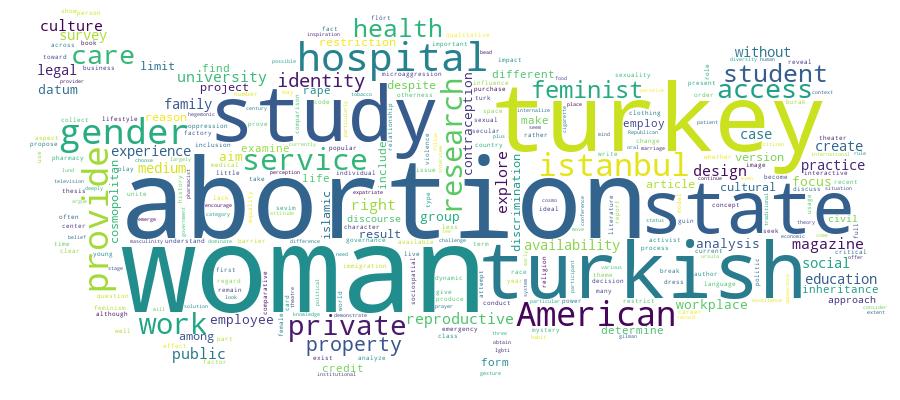
47 results
Scholarly Output Search Results
Now showing 1 - 10 of 47
Article Identity and the Availability of Emergency Contraception From Pharmacies in Istanbul(2021) Oneıl, Mary Lou; Fidan, Bahar Aldanmaz; O'neil, Mary Lou; Aldanmaz, BaharEmergency contraception (EC) has been and remains available in Turkey without prescription since 2002. This study attempted to determine the availability of emergency contraception from pharmacies in Istanbul, Turkey and whether the identity of the purchaser had any impact on availability. More specifically, we sought to understand if young women feel shamed or denied access to EC. This study employed a mystery patient/shopper approach where mystery patients attempted to purchase emergency contraception from a random sample of 352 pharmacies in Istanbul. Mystery shoppers, ages 18-22, were trained and provided a standard scenario and identity. The identities included: conservative/ religious female; secular/modern female; and male. After each pharmacy visit, the mystery patients recorded the details of their attempts to purchase EC. In 95.4% of visits mystery shoppers were able to purchase EC. Despite the availability of several types of EC, little choice was given to shoppers. Male mystery shoppers were given more choice of EC than their female counterparts and were more often able to purchase the less expensive form of EC. In the majority of transactions, pharmacists offered no medical instructions or recommendations. EC is widely available from pharmacies in Istanbul but lack of choice and information from pharmacists result in a less than ideal health care experience.Article Citation - WoS: 21Citation - Scopus: 20"it Was as If Society Didn't Want a Woman To Get an Abortion": a Qualitative Study in Istanbul Turkey(Elsevier Science Inc, 2017) MacFarlane, Katrina A.; O'Neil, Mary Lou; Tekdemir, Deniz; Foster, Angel M.Introduction: In 1983 abortion without restriction as to reason was legalized in Turkey. However at an international conference in 2012 the Prime Minister condemned abortion and announced his intent to draft restrictive abortion legislation. As a result of public outcry and protests the law was not enacted but media reports suggest that barriers to abortion access have since worsened. Objectives: We aimed to conduct a qualitative study exploring women's recent abortion experiences in Istanbul Turkey. Study design: In 2015 we conducted 14 semi-structured in-depth interviews with women aged 18 or older who had obtained abortion care in Istanbul on/after January 1 2009. We employed a multimodal recruitment strategy and analyzed these interviews for content and themes using deductive and inductive techniques. Results: Women reported on a total of 19 abortions. Although abortion care is available in private facilities only one public hospital provides abortion services without restriction as to reason. Women who had multiple abortions in different facility types described quality of care more positively in the private sector. Unmarried women considered their marital status when making the decision to seek an abortion and reported challenges obtaining comprehensive sexual and reproductive health services. All participants were familiar with the Turkish government's antiabortion discourse and believed that this was reflective of an overarching desire to restrict women's rights. Conclusion: Public abortion services in Istanbul are currently limited and private abortion services are accessible but relatively expensive to obtain. Recent antiabortion political rhetoric appears to have negatively impacted access and service quality. Implications: This is the first qualitative study exploring women's experiences obtaining abortion services in Turkey since the proposed abortion restriction in 2012. Further research exploring the experiences of unmarried women and abortion accessibility in other regions of the country is warranted. (C) 2017 Elsevier Inc. All rights reserved.Article Citation - WoS: 5Citation - Scopus: 4The Availability of Emergency Contraception From Family Health Centers in Turkey(Elsevier Ireland Ltd, 2022) O'Neil, Mary Lou; Aldanmaz, Bahar; Altuntas, DenizReproductive health care, including contraception, is a fundamental aspect of any public health care system and it is important to reduce barriers to access to all forms of contraception, including emergency contraception. In recent years, the rhetoric of pronatalism in Turkey has come to dominate and raises questions about the availability of reproductive health care services, in particular contraception, from state run facilities. This study aimed to determine the availability of dedicated emergency contraception (EC) from government run Family Health Centers (FHCs) in Turkey. In 2019, a team of trained researchers called a random sample of 583 FHCs located in the largest cities in twelve regions across Turkey asking for dedicated EC. Dedicated EC is largely unavailable from government supported FHCs. Only 6.1% stated that they provided EC while 53.8% stated that it was not available and that they could provide no alternative. A further 28.3% declared that they could provide an alternative to dedicated EC that almost always consisted of oral contraceptives. We found statistically significant variations in response rate and availability among cities as well as the rate of referral to pharmacies. There is little access to EC from government sponsored health clinics designated to provide family planning services, which hinders access to an essential reproductive health care service that should be available to women everywhere.Article Citation - WoS: 1Citation - Scopus: 1Workplace Microaggressions Against LGBTI Plus Employees in Turkey: a Thematic Analysis of Environmental and Interpersonal Discrimination(Emerald Group Publishing Ltd, 2025) Selen, Eser; O'Neil, Mary Lou; Ergun, Reyda; O’Neil, Mary LouPurposeThe current study aimed to determine the extent and scope of microaggressions in the workplace directed towards LGBTI+ employees in Turkey.Design/methodology/approachThe research used both quantitative and qualitative data based on 664 statements made by individuals in the "The Situation of LGBTI+ Employees in the Private and Public Sector in Turkey" survey conducted between 2015 and 2020 (n = 2,695). The quantitative data consist of frequencies and the qualitative data center on answers to nine open ended questions regarding LGBTI+ individuals' experiences of discrimination in the workplace. We employed the taxonomy proposed by Nadal et al. (2010) to determine which actions constituted microaggressions and the form they took. We also conducted a critical discourse analysis of the open-ended questions where individuals described their experiences of microaggressions.FindingsMicroaggressions directed at LGBTI+ employees are pervasive in Turkey. Microaggressions largely follow the taxonomy created by Nadal et al. (2010) although we did not find microaggressions in all of the taxonomy's categories. We found that microaggressions mostly take the form of phobic language and mockery followed by heteronormativity, exoticization and disapproval. Two further categories, othering and threatening behaviors, emerged from our data.Originality/valueThis study addresses a significant gap in the literature on workplace microaggressions against LGBTI+ individuals, particularly in non-Western contexts. To our knowledge, it is the first study of its kind conducted in a non-Western Muslim-majority country. The research uniquely captures and critically analyzes the lived experiences of LGBTI+ employees through their own narratives, examining how microaggressions manifest as discriminatory discourses in the workplace.Article Citation - Scopus: 10Religion as a factor influencing turkish women's decisions to work(2013) O'Neil, Mary Lou; Bilgin, Mehmet HüseyinThis article uses survey data collected from more than 500 women in Istanbul to examine whether or not religion exerts an influence on women's decisions to work or not. Our work revealed that religion does not appear to have a direct impact on whether or not Turkish women choose to work. Rather the expectation that women fulfill their traditional roles as caregivers proves a greater obstacle for women who wish to enter the labor market. Religion, in the case of Turkey, Islam, can only be seen asan influence on Turkish women's work decisions to the extent that it supports "patriarchal mentalities" which define women first and foremost as mothers and caregiversArticle Citation - WoS: 7Citation - Scopus: 11Selfish Vengeful and Full of Spite: the Representations of Women Who Have Abortions on Turkish Television(2013) O'Neil, Mary LouThis article analyses the portrayal of women who have abortions in four recent Turkish television series Gümü? A?k-i Memnu Hanimin Ç iftlig. i andÖyle Bir Geçer Zaman ki all of which appeared between 2005 and 2011. It is clear from the varying storylines of these melodramas that the depiction of women who have abortions on Turkish television is decidedly negative. The women who have abortions are seen as defying cultural expectations to place motherhood before all else. They are portrayed as cheating on their husbands having sex outside of marriage and prioritizing career over marriage and family. The negative portrayal of women who have abortions in Turkish soap operas perpetuates the discourse on Republican womanhood which prescribes motherhood as women's national duty and as being at the core of their identity. © 2013 Taylor and Francis.Master Thesis A Comperative Look at Media Literacy Education in Turkey Focusing on the Shift To a More Critical Approach and New Media Updates in the Curriculum(Kadir Has Üniversitesi, 2016) Goysari, Merve; O'Neil, Mary LouThis thesis aims to examine the changing approach towards media literacy education in Turkey. This change will be shown through an in depth comparison of the two course books of this lesson from years 2006 and 2015. The comparison shows a change towards a more critical approach. The newer version of the book blends new media elements throughout the book as a whole not just in one unit. The new book also aims to make the students more aware of the messages that are geared towards them from various media outlets on a daily basis. The newer version of the course is designed to encourage students to think more independently ask themselves the right questions and through tasks have a hands-on experience in creating media products. The comparison primarily aims to show the digital media the computer age and internet’s influence on the adapted curriculum also how this change affects the students and encourages them to think more independently.Article Citation - WoS: 4Citation - Scopus: 15Competing Frameworks of Islamic Law and Secular Civil Law in Turkey: a Case Study on Women's Property and Inheritance Practices(Pergamon-Elsevier Science Ltd, 2015) Toktaş, Şule; O'Neil, Mary LouThe article stems from empirical research conducted with a group of women living in Istanbul who have conservative life styles bounded by an Islamic worldview. It attempts to illuminate the negotiation and contestation between the official civil law and Islamic law. The findings demonstrate that women inherit and bequeath property in a social setting where their gender roles are defined by their adherence to Islam. We argue that in Turkey women's inheritance practices are not determined solely in accordance with the secular civil law but rather are the result of a complex and intertwined combination of legal sources where an Islamic worldview often leads to the adoption of Islamic law. In other words the application of the secular civil law in Turkey is limited by the common practice of Islamic law. Rather than follow the gender equality mandated by the civil law the inheritance practices of many Islamic women are constituted with a deference to some aspects of Islamic law creating a situation of legal pluralism in Turkey. (C) 2014 Elsevier Ltd. All rights reserved.Article Citation - WoS: 25Citation - Scopus: 24The Availability of Abortion at State Hospitals in Turkey: a National Study(Elsevier, 2017) O'Neil, Mary LouIntroduction: Abortion in Turkey has been legal since 1983 and remains so today. Despite this in 2012 the Prime Minister declared that in his opinion abortion was murder. Since then there has been growing evidence that abortion access particularly in state hospitals is being restricted although no new legislation has been offered. Objectives: The study aimed to determine the number of state hospitals in Turkey that provide abortions. Study design: The study employed a telephone survey in 2015-2016 where 431 state hospitals were contacted and asked a set of questions by a mystery patient. If possible information was obtained directly from the obstetrics/gynecology department. I removed specialist hospitals from the data set and the remaining data were analyzed for frequency and cross-tabulations were performed. Results: Only 7.8% of state hospitals provide abortion services without regard to reason which is provided for by the current law while 78% provide abortions when there is a medical necessity. Of the 58 teaching and research hospitals in Turkey 9 (15.5%) provide abortion care without restriction to reason 38 (65.5%) will do the procedure if there is a medical necessity and 11 (11.4%) of these hospitals refuse to provide abortion services under any circumstances. There are two regions encompassing 1.5 million women of childbearing age where no state hospital provides for abortion without restriction as to reason. Conclusion: The vast majority of state hospitals only provide abortions in the narrow context of a medical necessity and thus are not implementing the law to its full extent. It is clear that although no new legislation restricting abortion has been enacted state hospitals are reducing the provision of abortion services without restriction as to reason. Implications: This is the only nationwide study to focus on abortion provision at state hospitals. (C) 2017 Elsevier Inc. All rights reserved.Article Citation - WoS: 1Citation - Scopus: 3Strangers To and Producers of Their Own Culture: American Popular Culture and Turkish Young People(2010) O'Neil, Mary Lou; Güler, FazilAmerican popular culture is virtually everywhere including Turkey. Turkey is a close ally of the United States and American cultural products have long been present in Turkey. How does the presence of American popular culture in Turkey affect young people? Employing a series of focus groups comprised of Turkish university students we explored the meanings they attach to American popular culture and the place it has in their lives. What emerged was a portrait of Turkish young people constructing themselves and their imaginations from a multiplicity of traditions including American into an ever changing shifting whole. The Turkish young people in this study seem to exemplify this as they blend their lives not always easily or smoothly around Turkish American European and numerous other cultures. © W. S. Maney & Son Ltd 2010.
