Bozkuş, Zeki

Loading...
Profile Picture
Name Variants
Bozkuş, Zeki
Z.,Bozkuş
Z. Bozkuş
Zeki, Bozkuş
Bozkus, Zeki
Z.,Bozkus
Z. Bozkus
Zeki, Bozkus
Bozkus,Z.
Job Title
Doç. Dr.
Email Address
Main Affiliation
Computer Engineering
Status
Former Staff
Website
ORCID ID
Scopus Author ID
Turkish CoHE Profile ID
Google Scholar ID
WoS Researcher ID

Sustainable Development Goals

4

QUALITY EDUCATION
QUALITY EDUCATION Logo

0

Research Products

6

CLEAN WATER AND SANITATION
CLEAN WATER AND SANITATION Logo

0

Research Products

10

REDUCED INEQUALITIES
REDUCED INEQUALITIES Logo

0

Research Products

13

CLIMATE ACTION
CLIMATE ACTION Logo

0

Research Products

14

LIFE BELOW WATER
LIFE BELOW WATER Logo

0

Research Products

2

ZERO HUNGER
ZERO HUNGER Logo

0

Research Products

8

DECENT WORK AND ECONOMIC GROWTH
DECENT WORK AND ECONOMIC GROWTH Logo

0

Research Products

12

RESPONSIBLE CONSUMPTION AND PRODUCTION
RESPONSIBLE CONSUMPTION AND PRODUCTION Logo

0

Research Products

9

INDUSTRY, INNOVATION AND INFRASTRUCTURE
INDUSTRY, INNOVATION AND INFRASTRUCTURE Logo

0

Research Products

17

PARTNERSHIPS FOR THE GOALS
PARTNERSHIPS FOR THE GOALS Logo

0

Research Products

1

NO POVERTY
NO POVERTY Logo

0

Research Products

11

SUSTAINABLE CITIES AND COMMUNITIES
SUSTAINABLE CITIES AND COMMUNITIES Logo

0

Research Products

15

LIFE ON LAND
LIFE ON LAND Logo

0

Research Products

3

GOOD HEALTH AND WELL-BEING
GOOD HEALTH AND WELL-BEING Logo

1

Research Products

7

AFFORDABLE AND CLEAN ENERGY
AFFORDABLE AND CLEAN ENERGY Logo

0

Research Products

5

GENDER EQUALITY
GENDER EQUALITY Logo

0

Research Products

16

PEACE, JUSTICE AND STRONG INSTITUTIONS
PEACE, JUSTICE AND STRONG INSTITUTIONS Logo

0

Research Products
This researcher does not have a Scopus ID.
This researcher does not have a WoS ID.
Scholarly Output

29

Articles

7

Views / Downloads

8/0

Supervised MSc Theses

9

Supervised PhD Theses

0

WoS Citation Count

107

Scopus Citation Count

183

WoS h-index

5

Scopus h-index

8

Patents

0

Projects

0

WoS Citations per Publication

3.69

Scopus Citations per Publication

6.31

Open Access Source

22

Supervised Theses

9

JournalCount
Journal of Parallel and Distributed Computing2
Frontiers in Neuroinformatics2
2013 High Capacity Optical Networks and Emerging/Enabling Technologies, HONET-CNS 2013 -- 10th International Conference on High Capacity Optical Networks and Emerging/Enabling Technologies, HONET-CNS 2013 -- 11 December 2013 through 13 December 2013 -- Famagusta -- 1028061
2015 IEEE International Conference on Computer and Information Technology; Ubiquitous Computing and Communications; Dependable, Autonomic and Secure Computing; Pervasive Intelligence and Computing1
2015 International Conference on Emerging Technologies (ICET)1
Current Page: 1 / 3

Scopus Quartile Distribution

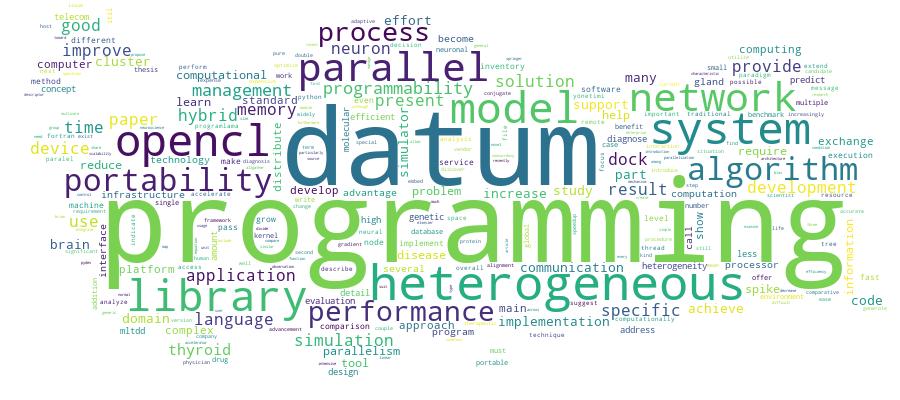
Competency Cloud

GCRIS Competency Cloud

Scholarly Output Search Results

Now showing 1 - 10 of 29
  • Article
    Optimizing Neuron Simulation Environment Using Remote Memory Access With Recursive Doubling on Distributed Memory Systems
    (Hindawi Ltd, 2016) Shehzad, Danish; Bozkuş, Zeki
    Increase in complexity of neuronal network models escalated the efforts to make NEURON simulation environment efficient. The computational neuroscientists divided the equations into subnets amongst multiple processors for achieving better hardware performance. On parallel machines for neuronal networks interprocessor spikes exchange consumes large section of overall simulation time. In NEURON for communication between processors Message Passing Interface (MPI) is used. MPI Allgather collective is exercised for spikes exchange after each interval across distributed memory systems. The increase in number of processors though results in achieving concurrency and better performance but it inversely affects MPI Allgather which increases communication time between processors. This necessitates improving communication methodology to decrease the spikes exchange time over distributed memory systems. This work has improved MPI Allgather method using Remote Memory Access (RMA) by moving two-sided communication to one-sided communication and use of recursive doubling mechanism facilitates achieving efficient communication between the processors in precise steps. This approach enhanced communication concurrency and has improved overall runtime making NEURON more efficient for simulation of large neuronal network models.
  • Article
    Citation - WoS: 27
    Citation - Scopus: 27
    Exploiting Heterogeneous Parallelism With the Heterogeneous Programming Library
    (Academic Press Inc Elsevier Science, 2013) Vinas, Moises; Bozkuş, Zeki; Fraguela, Basilio B.
    While recognition of the advantages of heterogeneous computing is steadily growing the issues of programmability and portability hinder its exploitation. The introduction of the OpenCL standard was a major step forward in that it provides code portability but its interface is even more complex than that of other approaches. In this paper we present the Heterogeneous Programming Library (HPL) which permits the development of heterogeneous applications addressing both portability and programmability while not sacrificing high performance. This is achieved by means of an embedded language and data types provided by the library with which generic computations to be run in heterogeneous devices can be expressed. A comparison in terms of programmability and performance with OpenCL shows that both approaches offer very similar performance while outlining the programmability advantages of HPL. (C) 2013 Elsevier Inc. All rights reserved.
  • Master Thesis
    Use of Machine Learning Techniques for Diagnosis of Thyroid Gland Disorder
    (Kadir Has Üniversitesi, 2016) Mofek, Izdihar; Bozkuş, Zeki
    The advancements of computer technologies have generated an incredible amount of data and information from numerous sources. Nowadays the way of implementing health care are being changing by utilizing the benefits of advancements in computer technologies. it is believed that engineering this amount of data can assist in developing predictive tool that can help physicians to diagnosing and predicting some debilitating life-threatening illness such as thyroid gland disease. Our current work focuses on investigating python languages to diagnose thyroid gland disease based on machine learning and involves developing a new tool to predict the diagnoses of thyroid gland diseases which we have called as a MLTDD (Machine Learning App for thyroid Disease Diagnosis). MLTDD has been designed with Qt designer and programmed using PyDev which is python iDE for Eclipse. MLTDD could diagnose with 99.81% accuracy. Decision tree algorithm has been used to create the ML model in addition to training dataset to learn from. ML model can be used to get predictions on new data for which you do not know the target and that is what we did to predict the diagnosis of thyroid gland disease as a hyperthyroidism or hypothyroidism or a normal condition using CRT decision tree algorithm. MLTDD can minify the cost the waiting time and help physicians for more research as well as decrease the errors and mistakes that can be made by humans on account of exhaustion and tiredness.
  • Master Thesis
    Hybrid Kmeans Clustering Algorithm
    (Kadir Has Üniversitesi, 2013) Çolakoğlu, Mustafa Alp; Bozkuş, Zeki
    From the past up to the present size of the data is rapidly increasing day by day. Growing dimensions of this data can be held in databases is seen as a disadvantage. Companies have seen this information in databases as an excellent resource for increasing profitability. According to this source the profiles of the customers can be clustering and new products can be presented for cluster customers. So data mining algorithms are needed for rapidly examine these sources of information and obtaining meaningful information from resources.This project has been implemented K-means clustering algorithm with the hybrid programming method. This project suggested that data grouped with hybrid programming takes less time. Algorithm accelerated with hybrid programming method. Parallel programming used to solve K-means problem with using multi- processor and threads used for running operations at the same time. Hybrid version of K-means clustering algorithm was written using the C programming language. Existing parallel K-means source code used thread structure is added. Message Passing interface library and POSiX threads are used. Hybrid version of K-means algorithm and parallel K-means algorithm are run many times under the same conditions and comparisons were made. These comparisons were transferred to the tables and graphs. -- Abstract'tan.
  • Conference Object
    Citation - WoS: 1
    Citation - Scopus: 1
    Accelerating Brain Simulations on Graphical Processing Units
    (IEEE, 2015) Kayraklıoğlu, Engin; El-Ghazawi, Tarek A.; Bozkuş, Zeki
    NEural Simulation Tool(NEST) is a large scale spiking neuronal network simulator of the brain. In this work we present a CUDA(R) implementation of NEST. We were able to gain a speedup of factor 20 for the computational parts of NEST execution using a different data structure than NEST's default. Our partial implementation shows the potential gains and limitations of such possible port. We discuss possible novel approaches to be able to adapt generic spiking neural network simulators such as NEST to run on commodity or high-end GPGPUs.
  • Conference Object
    Citation - Scopus: 4
    A Software Architecture for Inventory Management System
    (2013) Arsan, Taner; Başkan, Emrah; Ar, Emrah; Bozkuş, Zeki
    Inventory Management is one of the basic problems in almost every company. Before computer age and integration paper tables and paperwork solutions were being used as inventory management tools. These we very far from being a solution took so much time even needed employees just for this section of organization. There was no an efficient solution available in the many companies during these days. Every process was based on paperwork human fault rate was high the process and the tracing the inventory losses were not possible and there was no efficient logging systems. After the computer age every process is started to be integrated into electronic environment. And now we have qualified technology to implement new solutions to these problems. Software based systems bring the advantages of having the most efficient control with less effort and employees. These developments provide new solutions for also inventory management systems in this context. In this paper a new solution for Inventory Management System (IMS) is designed and implemented. Most importantly this system is designed for Kadir Has University and used as Inventory Management System. © 2013 Springer Science+Business Media.
  • Article
    Citation - Scopus: 27
    Exploiting Heterogeneous Parallelism With the Heterogeneous Programming Library
    (2013) Viñas,M.; Bozkus,Z.; Fraguela,B.B.
    While recognition of the advantages of heterogeneous computing is steadily growing, the issues of programmability and portability hinder its exploitation. The introduction of the OpenCL standard was a major step forward in that it provides code portability, but its interface is even more complex than that of other approaches. In this paper, we present the Heterogeneous Programming Library (HPL), which permits the development of heterogeneous applications addressing both portability and programmability while not sacrificing high performance. This is achieved by means of an embedded language and data types provided by the library with which generic computations to be run in heterogeneous devices can be expressed. A comparison in terms of programmability and performance with OpenCL shows that both approaches offer very similar performance, while outlining the programmability advantages of HPL. © 2013 Elsevier Inc. All rights reserved.
  • Conference Object
    Citation - Scopus: 8
    GPU accelerated molecular docking simulation with genetic algorithms
    (Springer Verlag, 2016) Altuntaş,S.; Bozkus,Z.; Fraguela,B.B.
    Receptor-Ligand Molecular Docking is a very computationally expensive process used to predict possible drug candidates for many diseases. A faster docking technique would help life scientists to discover better therapeutics with less effort and time. The requirement of long execution times may mean using a less accurate evaluation of drug candidates potentially increasing the number of false-positive solutions, which require expensive chemical and biological procedures to be discarded. Thus the development of fast and accurate enough docking algorithms greatly reduces wasted drug development resources, helping life scientists discover better therapeutics with less effort and time. In this article we present the GPU-based acceleration of our recently developed molecular docking code. We focus on offloading the most computationally intensive part of any docking simulation, which is the genetic algorithm, to accelerators, as it is very well suited to them. We show how the main functions of the genetic algorithm can be mapped to the GPU. The GPU-accelerated system achieves a speedup of around ~ 14x with respect to a single CPU core. This makes it very productive to use GPU for small molecule docking cases. © Springer International Publishing Switzerland 2016.
  • Article
    Citation - Scopus: 2
    Developing Adaptive Multi-Device Applications With the Heterogeneous Programming Library
    (Kluwer Academic Publishers, 2015) Viñas,M.; Bozkus,Z.; Fraguela,B.B.; Andrade,D.; Doallo,R.
    The usage of heterogeneous devices presents two main problems. One is their complex programming, a problem that grows when multiple devices are used. The second issue is that even if the codes for these devices can be portable on top of OpenCL, they lack performance portability, effectively requiring specialized implementations for each device to get good performance. In this paper we extend the Heterogeneous Programming Library (HPL), which improves the usability of heterogeneous systems on top of OpenCL, to better handle both issues. First, we provide HPL with mechanisms to support the implementation of any multi-device application that requires arbitrary patterns of communication between several devices and a host memory. In a second stage HPL is improved with an adaptive scheme to optimize communications between devices depending on the execution environment. An evaluation using benchmarks with very different nature shows that HPL reduces the SLOCs and programming effort of OpenCL applications by 27 and 43 %, respectively, while improving the performance of applications that exchange data between devices by 28 % on average. © 2015, Springer Science+Business Media New York.
  • Correction
    Software for Brain Network Simulations: a Comparative Study (vol 11, 46, 2017)
    (Frontiers Media Sa, 2018) Tikidji-Hamburyan, Ruben A.; Narayana, Vikram; Bozkus, Zeki; El-Ghazawi, Tarek A.
    [No Abstract Available]