
Öztürk Danışman, Gamze
Loading...

Profile URL
Name Variants
Öztürk Danışman, Gamze
G.,Öztürk Danışman
G. Öztürk Danışman
Gamze, Öztürk Danışman
Ozturk Danisman, Gamze
G.,Ozturk Danisman
G. Ozturk Danisman
Gamze, Ozturk Danisman
Danışman, Gamze Öztürk
Ozturk-Danisman, Gamze
Danisman, Gamze Ozturk
G.,Öztürk Danışman
G. Öztürk Danışman
Gamze, Öztürk Danışman
Ozturk Danisman, Gamze
G.,Ozturk Danisman
G. Ozturk Danisman
Gamze, Ozturk Danisman
Danışman, Gamze Öztürk
Ozturk-Danisman, Gamze
Danisman, Gamze Ozturk
Job Title
Dr. Öğr. Üyesi
Email Address
Gamze.danı[email protected]
Main Affiliation
International Trade and Finance
Status
Former Staff
Website
ORCID ID
Scopus Author ID
Turkish CoHE Profile ID
Google Scholar ID
WoS Researcher ID
Sustainable Development Goals
 1
1NO POVERTY
0
Research Products
 2
2ZERO HUNGER
0
Research Products
 3
3GOOD HEALTH AND WELL-BEING
1
Research Products
 4
4QUALITY EDUCATION
0
Research Products
 5
5GENDER EQUALITY
0
Research Products
 6
6CLEAN WATER AND SANITATION
0
Research Products
 7
7AFFORDABLE AND CLEAN ENERGY
0
Research Products
 8
8DECENT WORK AND ECONOMIC GROWTH
3
Research Products
 9
9INDUSTRY, INNOVATION AND INFRASTRUCTURE
1
Research Products
 10
10REDUCED INEQUALITIES
6
Research Products
 11
11SUSTAINABLE CITIES AND COMMUNITIES
0
Research Products
 12
12RESPONSIBLE CONSUMPTION AND PRODUCTION
1
Research Products
 13
13CLIMATE ACTION
1
Research Products
 14
14LIFE BELOW WATER
0
Research Products
 15
15LIFE ON LAND
0
Research Products
 16
16PEACE, JUSTICE AND STRONG INSTITUTIONS
0
Research Products
 17
17PARTNERSHIPS FOR THE GOALS
0
Research Products

This researcher does not have a Scopus ID.

This researcher does not have a WoS ID.

Scholarly Output
18
Articles
16
Views / Downloads
220/2361
Supervised MSc Theses
2
Supervised PhD Theses
0
WoS Citation Count
798
Scopus Citation Count
897
Patents
0
Projects
0
WoS Citations per Publication
44.33
Scopus Citations per Publication
49.83
Open Access Source
10
Supervised Theses
2
| Journal | Count |
|---|---|
| SSRN Electronic Journal | 3 |
| Journal of Financial Stability | 2 |
| Ege Akademik Bakis (Ege Academic Review) | 1 |
| Ege Akademik Bakış | 1 |
| Finance Research Letters | 1 |
Current Page: 1 / 3
Scopus Quartile Distribution
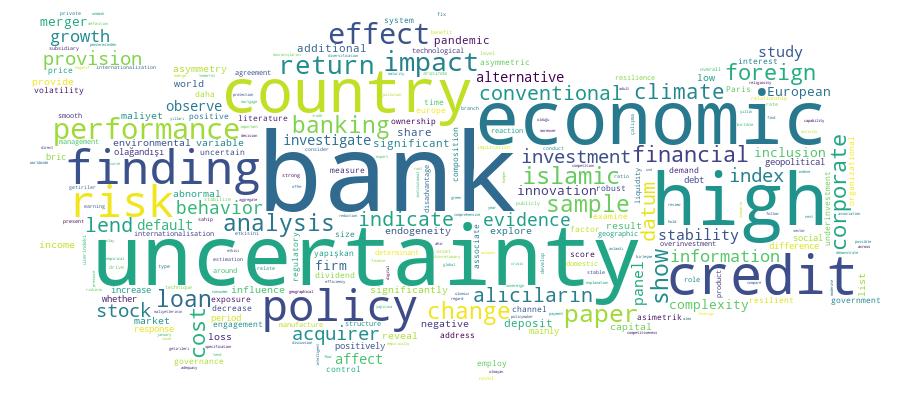
Competency Cloud
18 results
Scholarly Output Search Results
Now showing 1 - 10 of 18
Article Citation - WoS: 43Citation - Scopus: 45Bank Credit in Uncertain Times: Islamic Vs. Conventional Banks(Elsevier Ltd, 2020) Bilgin, Mehmet Hüseyin; Danışman, Gamze Öztürk; Demir, Ender; Tarazi, AmineThis paper explores whether the impact of economic uncertainty on credit growth differs for Islamic vs. conventional banks. Using a sample of 416 banks (58 Islamic and 358 conventional) in 12 countries, the findings indicate that an increase in economic uncertainty significantly decreases the credit growth of conventional banks but does not have any significant impact on Islamic banks’ credit growth. Our results are robust to alternative specifications and addressing endogeneity concerns using GMM estimators. We further observe that our findings are stronger for the following countries: (1) countries with explicit deposit insurance protection system for Islamic banks, (2) lower foreign dominance, and (3) countries with a higher share of deposits and assets in Islamic banks.Article Citation - WoS: 90Citation - Scopus: 101Economic Uncertainty and Bank Stability: Conventional Vs. Islamic Banking(Elsevier Science Inc, 2021) Bilgin, Mehmet Huseyin; Danisman, Gamze Ozturk; Demir, Ender; Tarazi, AmineIn this paper, we explore whether economic uncertainty differently affects the default risk of Islamic and conventional banks. Using a sample of 568 banks from 20 countries between 2009 and 2018, we use the World Uncertainty Index (WUI) by Ahir et al. (2018) to conduct a study based on a comparable measure across countries. Our findings indicate that economic uncertainty increases the default risk of conventional banks but does not affect Islamic banks' default risk. To understand why, we explore the influence of religiosity, institutional factors, and bank-level heterogeneity. We observe that Islamic banks' default risk is not significantly affected by uncertainty in all types of countries, but such a difference with conventional banks mainly holds for banks with higher income diversification, larger size, and that are publicly traded. Moreover, our findings show that conventional banks suffer more from uncertainty in terms of stability in countries with higher religiosity and with a higher share of profit-loss sharing (PLS) contracts. Our results are robust to alternative estimation techniques to deal with endogeneity and to alternative variable measurements.Article Citation - WoS: 86Citation - Scopus: 91The Impact of Economic Uncertainty and Geopolitical Risks on Bank Credit(Elsevier Inc., 2021) Demir, Ender; Danışman, Gamze ÖztürkThis paper compares the effects of economic uncertainty and geopolitical risks on bank credit growth. Using a sample of 2439 banks from 19 countries for the period of 2010–2019, our findings indicate that economic uncertainty causes a significant decrease in overall bank credit growth while no such significant overall effect of geopolitical risks is documented. Further analysis on loan types shows that the highest negative impact of economic uncertainty is observed on corporate loans. Geopolitical risk, however, dampens consumer and mortgage loans. Additional analyses on bank heterogeneity reveal that the credit behavior of foreign and publicly listed banks are more immune to such risks.Article Citation - WoS: 72Citation - Scopus: 88Banking Sector Reactions To Covid-19: the Role of Bank-Specific Factors and Government Policy Responses(Elsevier, 2021) Demir, Ender; Danisman, Gamze OzturkThis paper examines the impact of bank-specific factors and variations in the context of stringency of government policy responses on bank stock returns because of the COVID-19 pandemic. A sample of 1,927 publicly listed banks from 110 countries is used for the period of the first major wave of COVID-19, that is, January to May 2020. Our findings indicate that stock returns of banks with higher capitalization and deposits, more diversification, lower non-performing loans, and larger size are more resilient to the pandemic. While banks' environment and governance scores do not have a significant impact, higher social and corporate social responsibility strategy scores intensify the negative stock price reaction to COVID-19. We further observe that the pandemic induced reduction in bank stock prices is mitigated as the strictness of government policy responses increases, mainly through economic responses such as income support, debt and contract relief, and fiscal measures from governments.Article Citation - WoS: 2Citation - Scopus: 4Economic Uncertainty and Climate Change Exposure(Academic Press Ltd- Elsevier Science Ltd, 2025) Danisman, Gamze Ozturk; Bilyay-Erdogan, Seda; Demir, EnderThis paper explores how economic uncertainty affects firms' climate change exposure. We use an extensive sample from 24 countries from 2002 to 2021. Employing a novel measure of firm-level climate change exposure developed by Sautner et al. (2023b), we empirically demonstrate that prior to the Paris Agreement in 2015, economic uncertainty leads to a decrease in climate change disclosures. However, after the Paris Agreement, our findings reveal a positive association between economic uncertainty and climate change exposure. The positive disclosure effect is primarily driven by higher climate-related opportunities and regulatory exposures. Our findings are robust when we employ alternative definitions for economic uncertainty, alternative samples, additional firm-level and country-level control variables, and alternative methodologies. We find that institutional and foreign ownership positively moderates the association between economic uncertainty and climate change exposure after the Paris Agreement. Further analysis investigates the moderating impact of country-level environmental performance indicators. We present novel empirical evidence suggesting that firms operating in countries with less climate vulnerability, higher readiness, more stringent environmental policies, superior climate protection performance, and higher environmental litigation risk tend to have higher climate change exposure in uncertain times.Article Citation - WoS: 10Citation - Scopus: 12How Organizational and Geographic Complexity Influence Performance: Evidence From European Banks(Elsevier B.V., 2021) Nyola, Annick Pamen; Sauvlat, Alain; Tarazi, Amine; Danışman, Gamze Öztürk; Sauviat, AlainWe empirically investigate how bank internationalization, organizational complexity, and geographical complexity stemming from foreign-affiliate type and geographic dispersion affect parent bank stability and profitability. We base our analysis on unique, hand-collected data for the worldwide locations of subsidiaries and branches of EU banks. Our results show that internationalization benefits bank stability by reducing default risk, and it is significantly associated with lower earnings volatility but poorer profitability. With regard to foreign organizational complexity, banks with both foreign subsidiaries and foreign branches are more stable than banks with foreign branches exclusively, which are more stable than banks with only foreign subsidiaries. Nevertheless, higher geographic complexity is associated with lower default risk, higher volatility in earnings, and higher profitability. Further investigations on the sovereign debt crisis and bank size indicate that the sovereign debt crisis in 2011 amplified the relationship and our findings mainly hold for small banks.Article Citation - WoS: 1Citation - Scopus: 3The Effect of Pandemics on Domestic Credit: a Cross-Country Analysis(Economics Bulletin, 2021) Danisman, Gamze Ozturk; Demir, EnderUsing a panel of 140 countries covering the period 1996-2018, this paper examines how previous pandemics (such as SARS, MERS, Ebola, Swine flu, etc.) have influenced the lending behavior of banks. We take advantage of a new index developed by Ahir et al. (2020) which measures discussions about pandemics at the country level. Our findings reveal that uncertainty related to pandemics significantly hamper domestic credit available to the private sector. The negative effect of pandemics on credit levels is more prevalent for the low-income & emerging economies and non-OECD countries.Article Citation - WoS: 133Citation - Scopus: 136ESG performance and investment efficiency: The impact of information asymmetry(Elsevier, 2024) Bilyay-Erdogan, Seda; Danisman, Gamze Ozturk; Demir, EnderThis paper investigates the relationship between firms' engagement in environmental, social, and governance (ESG) activities and corporate investment efficiency, using 1,094 firms from 21 countries in Europe, covering the years 2002-2019. We conduct our estimations using fixed effects panel data techniques and address potential endogeneity with instrumental variables (IV) estimations. We provide evidence that overall ESG engagement is positively and significantly associated with investment efficiency. Analyzing overinvestment and underinvestment scenarios shows that ESG engagement decreases only overinvestment problems. Within the underinvestment scenario, we observe that ESG engagement is beneficial only for firms with higher information asymmetries. Thus, information asymmetry matters in the underinvestment case. We next show that four firm-level channels-information asymmetry, financial constraints, cash flows, and risk-link ESG performance to investment inefficiency. Additional analysis shows that firms with extreme ESG scores (i.e., very low and very high) do not experience significant reductions in investment inefficiency. Altogether, our findings draw attention to the critical role of ESG performance and information asymmetry in determining corporate investment efficiency.Article Citation - WoS: 95Citation - Scopus: 121Financial Inclusion and Bank Stability: Evidence From Europe(Routledge Journals, 2020) Danışman, Gamze Öztürk; Tarazi, AmineThe Great Recession of 2007-2009 piqued the interest of policymakers worldwide, prompting various initiatives to stabilize the financial system and advance financial inclusion. However, few studies have considered their interconnectedness or whether any synergies or trade-offs exist between them. This paper investigates how financial inclusion affects the stability of the European banking system. The findings indicate that advancements in financial inclusion through more account ownership and digital payments have a stabilizing effect on the banking industry. A deeper investigation shows that such a stabilizing impact is mainly driven by the targeting of disadvantaged adults who are young, undereducated, unemployed, and who live in rural areas. Hence, along with its known benefits to society as a whole, financial inclusion has the additional benefit of improving the stability of the financial system. Such findings call for policy configurations that are specifically designed to achieve financial inclusion for disadvantaged individuals.Master Thesis Determinants of Bank Lending 'evidence From Brics Countries'(Kadir Has Üniversitesi, 2023) Ahmed, Abdullai; Öztürk Danışman, Gamze; Danışman, Gamze ÖztürkThis thesis aims to investigate the determinants of bank lending for the countries forming BRICS, namely Brazil, Russia, India, China, and South Africa. The empirical analysis is performed using a sample of 130 listed commercial banks between 2000 and 2021. While bank-level data is obtained from Thomson Reuters Refinitiv Eikon, country-level data is extracted from the World Bank. The study uses panel data estimation techniques with fixed effects regression models. Study findings show that bank size, capital adequacy ratio, credit risk, the share of deposits and return on asset have a direct influence on bank lending in BRICS countries since all these variables are statistically significant. Larger banks are observed to lend more, and banks with higher shares of deposit, higher capital adequacy ratios, higher return on assets and higher credit risk are observed to lend more. Country-level variables such as gross domestic product per capita, real interest rate, deposit interest rate, and lending interest rate have no direct impact on bank lending. In contrast, banks in countries with higher inflation lend more. This study points out differences in the determinants of bank lending in the BRICS countries versus the rest of the world and offers important policy implications.
